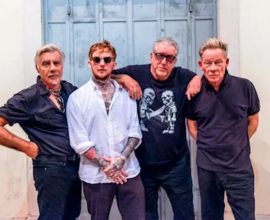
“Visuals play a key role in shaping how the music is experienced”, Strange Fruit
Coming out of Jakarta, Strange Fruit have never seemed interested in playing it safe. Over the past few years, they’ve been steadily building a sound that moves across boundaries—shoegaze, krautrock, electronica, and everything in between—always guided more by instinct than by calculation. With Drips, that journey finally starts to take on a clearer shape. Not in the sense of becoming simpler, but more focused. It feels like years of ideas, experiments and sketches have been reorganised into something that breathes more easily, while still carrying plenty of layers, textures and sonic friction. There’s density and noise, but also enough space for everything to exist without collapsing under its own weight. The result is a record that feels both like an evolution and a synthesis of everything the band has done so far. And with collaborations involving names like Tom Furse, Sean Johnston and Jonathan Kusuma, Drips also shows Strange Fruit in conversation with a wider world, without losing their identity in the process.
By Sandra Pinto
In this interview, we talk about how that balance was built, what has changed in their studio approach, and how a decade of sonic exploration eventually finds a point of convergence.
Drips is described as a journey to the edge of sonic consciousness. How did the idea to explore this more cohesive and atmospheric sound come about?
Baldi Calvianca: We spent more than a decade experimenting in the studio, especially with electronic instruments and textures. Over time, those shared explorations naturally evolved into a more unified, atmospheric sound, allowing us to fully embrace and incorporate the genres
we’ve been inspired by for years.
Irza Aryadiaz: During the pandemic, we spent a lot of time in the studio exploring electronic instruments and getting into similar sounds. It pushed us to finally bring in the genres we’d loved for years but hadn’t quite captured in our recordings. Bringing in our producer, Bernadus Fritz, really tied it all together.
The EP brings together fragments of your kosmische experimentation over the past 11 years. How did you decide which elements to keep and which to evolve?
Baldi Calvianca: We approached it as a process of distillation. Over the past 11 years, we’ve explored a wide range of ideas within our kosmische experimentation, but not everything needed to be carried forward in its original form. We focused on the elements that felt most
resonant and timeless, then reworked and evolved them into something more cohesive. In that way, the EP became a way of connecting those fragments into a unified, atmospheric narrative while still preserving the spirit of our earlier explorations.
Irza Aryadiaz: I think when we went through old demos, we’d pick out bits or layers we liked and re-record them into new tracks, again and again. It got a bit confusing at times, but it was so much fun to compute.
The video for Monopolar has an abstract, fluid aesthetic. What role do visuals play in how you want listeners to experience the music?
Baldi Calvianca: Visuals play a key role in shaping how the music is experienced. Since the track doesn’t rely on vocals to tell a story, the abstract and fluid imagery helps guide the listener emotionally rather than narratively. It creates a space where people can interpret the music in their own way, while still feeling a sense of cohesion between what they hear and what they see without limiting their interpretation.
The title track Drips blends shoegaze textures with electronic elements. How do you balance the sonic density with clarity and cohesion throughout the EP?
Baldi Calvianca: Shoegaze has become a core part of our identity, but I’ve never seen it as something confined to dense walls of guitar. I still remember hearing Blood Music by Chapterhouse—especially the reinterpretation by Global Communication and realizing how fluid the genre could be when combined with electronic elements. When it comes to balancing density with clarity, it’s really about intention and space. Even if there are a lot of layers, each element needs to have its own role and frequency range so nothing competes unnecessarily. We focus on dynamics and contrast knowing when to let things build and when to strip them back, so the track can breathe. At the same time, we don’t aim for perfection in the traditional sense. There’s always a bit of unpredictability in how we approach arrangements, which is part of the character. It might feel slightly overwhelming at moments, but that tension is deliberate—it keeps the music engaging while still holding everything together as a cohesive piece.
Irza Aryadiaz: I feel like shoegaze has been leaning a bit too hardcore lately, or maybe it’s just a shift in sound. So I added some 303s and layers to one of our tracks to show it can live in any genre.
You worked with international producers like Hardway Bros, Tom Furse, and Jonathan Kusuma. How was the collaboration with them, and what new perspectives did they bring to your sound?
Baldi Calvianca: We’ve been fans of their work for a long time, so working with Hardway Bros, Tom Furse, and Jonathan Kusuma felt pretty organic. In Jakarta, Hardway Bros and Tom Furse have already shaped our taste a lot—especially through our label nights where their tracks are always in the mix. Jonathan’s also a friend, and I’ve been following his stuff for years, so it all came together quite naturally.
What really sets all three apart is the character they bring to a track. Nothing feels overcooked or thrown in for the sake of it—every detail has a purpose. It’s tight, it’s intentional, but it still keeps that raw, expressive edge intact. Proper style without losing the soul—that’s the sweet
spot.
Irza Aryadiaz: I used to watch Tom Furse with The Horrors back when I was in college, honestly, it was beyond amazing. The way he pulled everything into one cohesive track really stuck with me. Same with Hardway Bros, three tracks, 303 all night to end the whole EP. Salute
to Jonathan Kusuma,I really love how he edits Baldi’s vocals.. Tracks like that are spot on for a dancefloor or a rave up in the mountains too. Perfect.
Pouvoir Moteur channels motorik rhythms inspired by German krautrock. How important are these repetitive structures in creating the sense of journey and hypnosis?
Baldi Calvianca: The repetition is essential—it creates a constant pulse that anchors the track. From there, the journey comes through subtle changes and layering, which build a hypnotic effect without breaking that flow.
Irza Aryadiaz: Kraftwerk’s Autobahn is quite important to me. Since I live outside the city centre, I often listen to it in the car. In “Pouvoir Moteur,” I was inspired by the highway too, how machines and vehicles run nonstop, 24 hours a day. Maybe that’s what best represents the 4/4 motorik beat. The flow and the current are the key to this journey.
The EP combines machine-driven rhythms with analog textures. What challenges did you face integrating electronic and organic elements so seamlessly?
Baldi Calvianca: It mostly comes down to production—figuring out how to sync analog and digital elements without losing the character of either. One of the main challenges is preserving the full range and texture of the sounds we create, so nothing feels flattened or overly
processed. Bernardus Fritz and Nabil Favian played a big role in making that balance work. They really helped in shaping how everything sits together without compromising the overall aesthetic. At the same time, since we approach this as a live band, we’re always thinking about how these tracks will translate outside the studio. So a big part of the process is making sure the electronic and organic elements can coexist naturally in a live setting—not just sound good on record, but actually feel right when performed.
Since your 2015 debut EP Dolphin Leap, the band has moved between noise pop, shoegaze, krautrock, and electronica. How would you define the sound of Drips in relation to your previous work?
Baldi Calvianca: Drips feels like a more focused version of what we’ve been building over the years. The shoegaze and noise elements are still there, but now they sit more naturally alongside electronic and rhythmic structures. It’s less scattered, more unified.
Baldi Calvianca describes the vocals as mercurial, merging with bursts of light. What role do the vocals play in constructing the EP’s sonic narrative?
Baldi Calvianca: I think vocals for me personally aren’t meant to sit on top of the track. They’re something we blend into the arrangement. We treat them like another texture, finding the most natural way for them to exist within the sound. Sometimes they drift in and out, almost like light passing through, shaping the mood rather than telling a clear story.
What message or feeling do you hope listeners take away after experiencing Drips?
Baldi Calvianca: Hopefully it leaves people in a good kind of haze—like getting lost in the noise and coming out the other side somewhere different. We want it to feel immersive, a bit disorienting, but in a way that sticks with you. Something you don’t just hear, but actually feel
long after it’s over.
Irza Aryadiaz: Hope we can relax and “santai” together in the future.
The EP will be released on cassette and vinyl later this year. How important are physical formats for your audience and for the music experience?
Baldi Calvianca: Physical releases have always been important to me on a personal level—they’re where you can truly experience the music in its fullest quality. I also believe that listening to an album from start to finish is a ritual worth preserving, something we shouldn’t lose
over time.
Irza Aryadiaz: It’s important to have physical releases. I’ve been collecting vinyl, there’s something about having the artwork in your room and being able to play it anytime. It creates a deeper connection to the music, especially when it’s on wax.
After Drips, what are the next steps or projects Strange Fruit plans to explore, especially regarding international collaborations and live performances?
Baldi Calvianca: We’re on our way to do our debut album and hopefully we’ll have it finished by next year. At the same time, we’re also looking to expand our live presence internationally—so if there are any booking agents reading this around the world, feel free to get in touch. We’re available… and occasionally well-behaved.
Irza Aryadiaz: Can’t wait! Maybe we’ll look towards a collaboration or a split EP with bands / producers across the country. With everything going on geopolitically, it feels like art is one of the few things that still keeps us connected.
‘Drips’ album https://strangefruit.bandcamp.com/album/drips