Thunder Rising: “We simply do what we know how to do best and what we’ve done all our lives”
Blending the raw energy of classic hard rock with modern production finesse, Thunder Rising has crafted a sound that bridges decades while staying undeniably fresh. Their latest album, Horizon Line, is a masterclass in merging vintage influences with contemporary techniques, using authentic Hammond organs, Marshall amps, and Fender guitars alongside cutting-edge recording technology. Fronted by Frank and Corrado, Thunder Rising channels the spirit of rock’s golden eras—from Whitesnake and Journey to Van Halen—while infusing their own personality and modern sensibilities. Described as a musical road trip through the ‘70s, ‘80s, and even ‘90s, Horizon Line captures both the warmth of analog instrumentation and the clarity of today’s production, delivering a sonic journey that appeals to longtime fans and new listeners alike.
By Sandra Pinto
In this interview, the band discusses the balance between vintage and modern, the influences that shaped the record, their songwriting process, and how they aim to translate the album’s rich sound into a live setting—all while keeping the heart of rock alive.
“Horizon Line” fuses classic hard rock with modern production. How did you approach balancing vintage influences with contemporary sound?
Frank: Hi everyone, and thanks for the great question! That is exactly the core mission of the Thunder Rising project: to reclaim a vintage repertoire and bring it into the modern world, almost like a time machine. We achieve this by using authentic vintage instruments—such
as the Hammond organ, Marshall amps, and many others—while employing modern recording techniques, specialized plugins, and digital mastering. Even the songwriting sits right between the past and the present, blending blues and pentatonic scales with more contemporary arrangement choices, especially when it comes to our vocal harmony techniques.
Can you describe what “Real Vintage” means to Thunder Rising and how it shaped this album?
Frank: It’s “Real Vintage” because we actually lived through those times, and our groove is exactly that of the 70s! It’s not an imitation. However, everything is presented in a new light, with a brilliant, crystal-clear, and polished sound. We imagined a teenager falling asleep in
1979 and waking up today—that’s how our vision was born.
Which bands or albums from the golden era of rock had the most impact on the writing and recording of “Horizon Line”?
Corrado: The bands are so many and they are certainly the ones that have left an indelible mark on the Hard Rock and Heavy Metal scene of the ‘80, but also partly of the 70s. I’m referring to Whitesnake, Boston, Journey, Van Halen and there’s also a pinch of Prog Rock if you listen carefully.
The album is described as a musical road trip. Was there a particular narrative or emotional journey you aimed to take listeners on?
Frank: Absolutely. While our previous album,”Back to the Time of Rock” was clearly set in the 70s, with this one we’ve moved into the 80s and even the 90s, touching on other genres. Every track is an explicit nod to bands like Deep Purple and Whitesnake, as well as Journey,
Van Halen, and many others—but without ever “copying” them. It’s a tribute to their inspiration and a journey through the history of Rock, written in our own way and with our own personality.
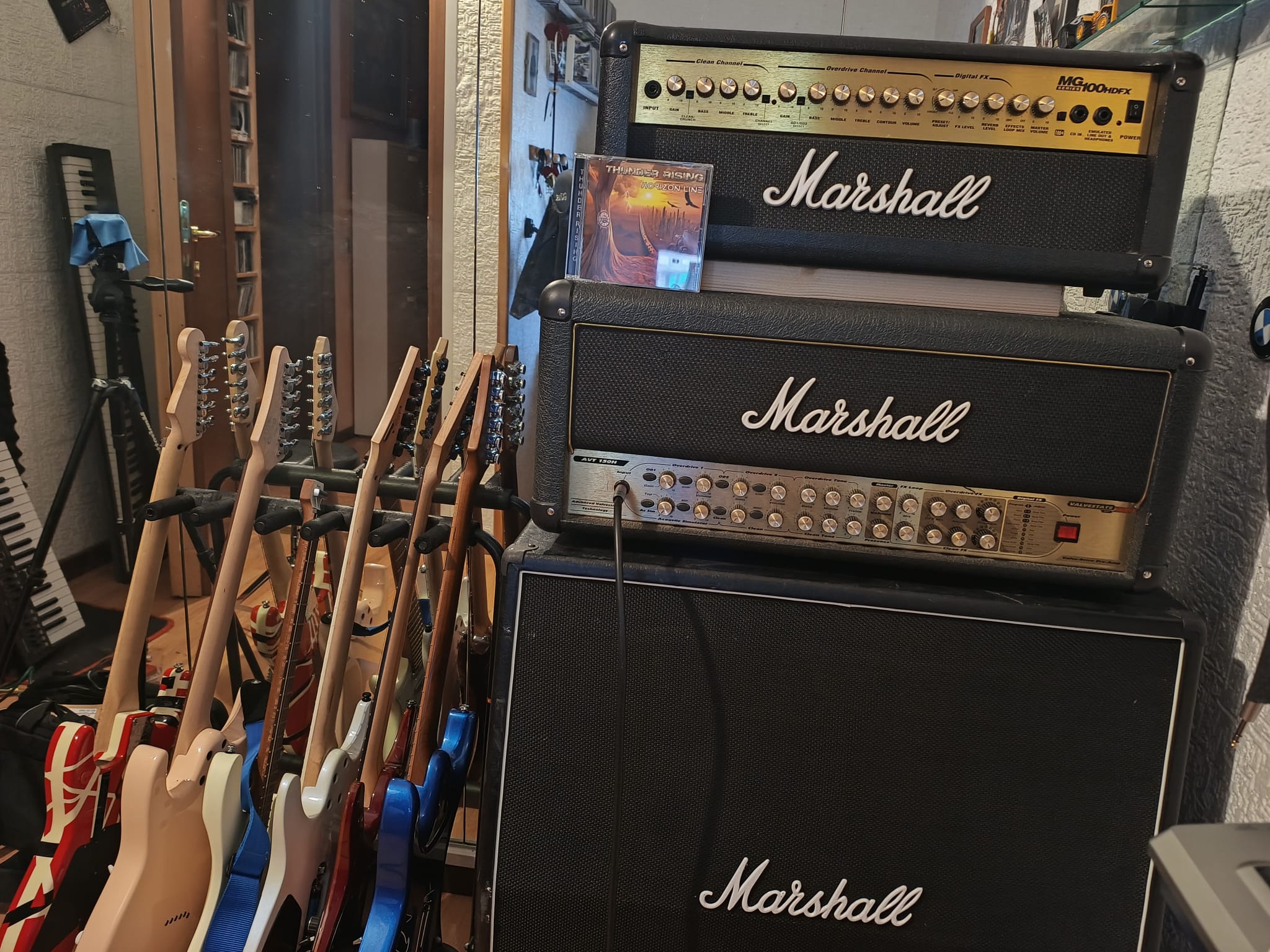 How do Hammond organs, Fender guitars, and Marshall amps contribute to the signature sound of the album?
Frank: It’s fundamental, because when you record with original instruments, you realize how Marshall frequencies were already designed to blend perfectly with Hammond keyboards, creating unmistakable tonal colors. In fact, the songwriting itself happened using these exact instruments. I could send you a photo of what’s behind me: a Marshall stack with two heads, always by my side to give me inspiration.
Were there any challenges in capturing the warmth and energy of classic rock while using modern production techniques?
Corrado: The advantage of modern productions is precisely the availability of an impressive amount of hardware and software with which you can do anything you can think of, as long as you know exactly what you want to achieve and how. You have access to any kind of amplifier, effect, keyboard. We went beyond that: we wanted to use real, truly vintage instruments and amplification, with very little digital involved. We are very satisfied with the final result.
Thunder Rising has roots in bands like Firehouse, Arachnes, and Wine Spirit. How have those experiences influenced the chemistry on this album?
Corrado: We’ve been friends for many years; we shared our first professional experiences when we were still teenagers and we grew up with the same records spinning on the turntable. It’s clear that our experiences and musical tastes first flowed into the bands you mentioned and then into Thunder Rising, which is the summary of a lifetime spent playing Rock ’n’ Roll.
Collaborations with legends like Mike Portnoy, Jeff Scott Soto, and Mark Boals have shaped your careers. Did those experiences influence “Horizon Line”?
Frank: Absolutely, yes. Especially with Mark, who was the official singer on our first album and with whom we co-wrote several tracks. The songwriting of Mark Boals and Jeff Scott Soto is unique and unmistakable. But beyond that, it was their professionalism—it was fantastic how Mike Portnoy sent over his drum tracks—and their humility that truly gave me a boost. We worked together as if we had been friends for a long time. They are incredible professionals who are eager to share their knowledge with those who share the same professional and life path; it’s as simple as that. It’s actually very straightforward, but you have to truly believe in it.
Which track on the album best represents the band’s vision for this project, and why?
Frank: This album has two sides, just like an old vinyl record, so I think picking just one track is impossible. I believe there are two distinct souls here: one is more AOR, and for that, the key track is definitely “Can’t Forget Your Voice” the other is more Hard Rock, represented by
“Mad Machine”, for which the official video will be available soon.
Many classic rock albums have a timeless feel. What steps did you take to ensure “Horizon Line” resonates both with longtime rock fans and new listeners?
Corrado: There’s no secret to reveal, no magic wand. We simply do what we know how to do best and what we’ve done all our lives. We basically play what we like; we don’t think about hits or fame. Of course, if that comes, we’re over the moon, but it’s not what we think about when we’re composing or playing live. In the end, if you do what you truly believe in, and the result satisfies you as it does in this case, then you’ve achieved your goal and the satisfaction is at its highest. I’m sure the fans will feel this energy and the good vibes that we felt ourselves.
How did the songwriting process work for this album? Did the band write collectively or did individual members bring in complete ideas?
Frank: Usually, I start with a guitar riff and a rough vocal demo, then Alessio presents his own proposal. Finally, we evaluate the different versions together and all contribute to the final result. That is exactly what creates the “Thunder Rising Sound&”.
Was there a particular theme, mood, or story that guided the overall tone of “Horizon Line”?
Frank: Absolutely, and the cover art is the symbol of it: a journey toward the horizon as if it were a destination, a final goal, or perhaps a new beginning. It represents something unknown that stirs our hearts and keeps us moving forward along an endless road, where we encounter emotions, people, life stories, and so much more.
Live energy is a big part of Thunder Rising’s identity. How do you plan to translate the album’s sound into a live setting?
Frank: The song structures are designed to work incredibly well live. My brother Enzo alternates between keyboards and guitars, which allows us to maintain a consistently rich and full sound.
In the age of digital streaming, what does it mean for you to produce an album that celebrates analog warmth and classic rock instrumentation?
Frank: It is a provocation, a deliberate choice, and the album will also be released across all digital channels. This is our message of Music and our love for it: to bring this sound to the attention of younger generations. However, this didn’t stop us from creating a physical format, and for that, I want to thank the publisher Mediaset and our label and distributor, Wormholedeath, for believing in us and supporting us. Just like in the 70s and 80s, I found people who were willing to take the time to share a journey, and for that, I will never stop thanking them.
Looking back on “Horizon Line,” what do you hope listeners take away from this journey through time and rock history?
Frank: It’s the romantic side of Rock—people used to say “Peace and Love” and we aren’t far from that. In a broader sense, it’s about inner well-being, hope for tomorrow, and above all… ROCK!