PHAETON: “You have to enjoy what you’re playing, and then the burn feels good. No pain, no gain”
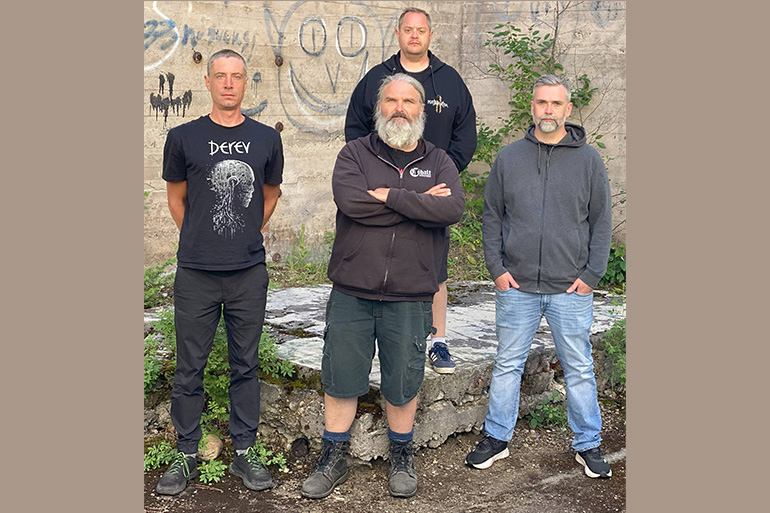
PHAETON, the Canadian instrumental powerhouse known for their technical, atmospheric prog-metal, returns with Neurogenesis, an album that delves into the blurred lines between humanity and technology. In this conversation with bassist Ferdy Belland, the band explores the inspirations behind the record, their distinctive approach to composition, the impact of special collaborations, and the challenge of translating complex transhumanist themes into riffs, rhythms, and textures.
By Sandra Pinto
From unsettling reflections on biomechanical augmentation to the intensity of their live performances, Belland reveals how tracks like Augmented capture the band’s relentless pursuit of sonic, narrative, and emotional innovation.
“Augmented” explores humanity’s drive to transcend its biological limits through technology. What was the first spark that inspired this concept?
Everyone in the band is thoughtful and intelligent, so when we get together and bullshit over beers, the conversations can veer off in dramatic directions, and we all dive pretty deep. The technological explosion of the 21st Century fascinates us and frightens us at the same time. When it comes to biomechanical medical breakthroughs, it’s one thing to talk about artificial hearts or bionic eyes or Teflon replacements for your kneecaps…but it’s another thing altogether to talk about wedging quantum-powered microchips into your cerebellum. Telepathic surveillance states? Skynet hive mind? I mean, hey, what could possibly go wrong? I shudder to think.
The band mentions “mechanical unease and robotic inhumanity.” How did you translate those feelings into riffs, rhythms, and textures?
We’re not afraid to explore odd time signatures and compound meters, and when the compositional approach’s handled properly, you can create the industrial lurch of a hulking battle-bot, or the rattling clank of a factory, or the chattering of terrified teeth. As an instrumental band, we love exploring dynamic rise and fall. Some of our riffs are downright djenty. Other riffs are hyper-melodic neo-classical spiralings. And other riffs fall somewhere in between or outside the box entirely. With no vocals or lyrical storylines for the instruments to hide behind, it’s almost the approach of a mad conductor flapping his arms over a nervous orchestra.
What do you hope viewers take away from the new playthrough video that they might not catch just by listening to the album version?
Besides our rugged Rocky Mountain handsomeness? I would hope the viewers would admire and covet Mike Honeyman’s amazing jamspace, which is where we filmed. Mike uses that place for intimate shows…I mean, fifty-clowns-jammed-into-a-telephone-booth intimate. You can see in the video how the four of us and all our gear absorbed virtually all of the available room. Now imagine shoving another 25 people in there. Things get hot and sweaty and crazy.
Is there a particular section of “Augmented” that was especially challenging or satisfying to perform in a playthrough format?
My particular favorite is at the 2:45-3:14 section where we’re all locking in on this hella-cool herky-jerky rhythm where the upper melody cycles repeatedly over a moving bass root that changes from F# to G to B to D…not to lapse into music-nerd geekery, but that section sets up such a great tension and release, and really makes the song for me.
How does “Augmented” fit into the overall narrative of Neurogenesis?
A: If the overarching concept of Neurogenesis discusses the human mind changing into something inhuman, then the biological augmentation of the human body, which is either right around the corner or already happening in some laboratory somewhere, is how Neurogenesis happens. This is not natural evolution. This is grotesque. This is the old Doctor Frankenstein myth, souped up with nanobots who have no sense of humor whatsoever. It stops being a hokey old episode of The Six Million Dollar Man and becomes this terrifying body-horror flick. Be careful when you’re playing God: play stupid games – win BIG prizes. It’s almost as if these arrogant eggheads never understood the meaning of the word “hubris”.
Neurogenesis marks a leap toward concise, dynamic songwriting. What motivated the shift toward more compact arrangements?
It wasn’t anything deliberate or pre-planned. It just happened that way. Kevin was working privately on his tunes, like “Arachnid” and “Isochron”. Dan was working privately on his songs, like “Augmented” and “Synesthesia”. I was working privately on “Tethys Rising”. So when we were ready to share the demo sketches with everybody else, we noticed that most of the gathered tunes were generally shorter than the songs on our previous album, Between Two Worlds. But we’re talking "short" meaning songs over six minutes long, so it’s
not as if we’re trying to impress Max Martin. We have short songs on our first album, too – check out “Labyrinth” sometime.
The album explores themes of technological singularity and cybernetic augmentation. Were there any real-world technologies or current events that influenced the writing process?
Where do I start? It’s as if we’re living in an episode of Black Mirror in real time, and it’s only going to accelerate and intensify as we ramp up to 2030 and beyond. Neurolink? CRISPR? The AI explosion of the past few years? I used to read all sorts of Golden Age science fiction when I was a teenager – Ray Bradbury, Robert A. Heinlein, Harry Harrison, Arthur C. Clark, Roger Zelazny, Harlan Ellison, you name it – and back then, the year 2025 was an unimaginably distant future, presented as this fantastic, gleaming, ultra-tech world of optimistic wonder…and instead we got TikToks. Nobody’s wearing tinfoil jumpsuits, nobody’s flying the hovercar to work, and the sidewalks don’t even move – no, the sidewalks just frost-heave and erode and crumble while we’re checking Trivago. We’ll probably have real-life Star Trek holodecks within the next ten years, and everyone will psychologically shatter because of it – just like Lieutenant Barclay did. Do you think people today have scrambled eggs for brains due to their current smartphone addictions? Hold my beer. It’s like the entire world pulled a Philip K. Dick Move.
How did having Kevin Thiessen handle engineering and mixing at The Cube shape the sound of the record?
We are beyond lucky and eternally grateful for having the myriad talents of the gifted Kevin Thiessen on hand for the whole wraparound Phaeton experience. Kevin was a model student when he attended the Selkirk College Contemporary Music Program and majored in engineering – he has A-level elite talents as a recording engineer and a producer, and we get compliments all the time about the ultra- professional quality of our finished albums. We’d have to shell out thousands of dollars to get the same quality level elsewhere, so we’re careful not to piss Kevin off. He always aims for crystalline perfection, and all of his mixes are balanced and huge-sounding. There’s always something new to discover when listening back to our earlier albums. To Kevin, obsession is a virtue, and he has no problem welding himself shut inside the Cube and laser-focusing on the mix with single-minded intensity.
What was Jamie Sitar’s impact during mastering — were there any surprising changes once he got involved?
The best mastering engineers are like publishing editors: you're not supposed to notice the changes to the story, but you do know that’s something’s changed for the better. And remember that Jamie Sitar is a Juno Award-winning engineer-producer, so we’re lucky once again to have him in the Phaeton camp. Jamie always returns the masters to us within days – he pays huge compliments to the professionalism of Kevin's submitted mixes. If the mastering engineer doesn’t have to agonize and curse time-consumingly over a lousy mix, then everybody wins. The album has to win, in the end.
The artwork by Matt Semenok visually complements the album’s themes. How did the collaboration develop, and what directions did you give him?
Colin met Matt through mutual friends in Calgary, and once again, it was a stroke of good luck for us. Colin's a fair illustrator, and he hand-drew the general concept of the human brain with the cybernetic implants and the power cables weaving through the cerebral cortex and such – he handed that off to Matt, along with a few notes about our desires for wraparound album art. We left Matt more or less to his own devices, and he blew us away with the end result. His murky watercolor style reminds me a lot of Bill Sienkiewicz (who did the artwork for Frank Miller's Elektra: Assassin), and Matt’s use of dark greens and subdued purples to imitate darkness was incredibly effective. We couldn’t be happier, and we’d gladly collaborate with him on future artwork needs, be it album covers or T-shirt designs or posters or stage backdrops or whatever. Iron Maiden had Derek Riggs. High on Fire had Arik Roper. Yes had Roger Dean. We have Matt Semenok.
Derek Sherinian’s guest appearance on “Isochron” is a major highlight. How did this collaboration come together?
We’re still pinching ourselves to ensure that Derek Sherinian himself did indeed work with little old us. Colin made that one happen. Way back during the recording sessions for Between Two Worlds, we discussed recruiting different guest collaborators for certain songs, but we never took the idea anywhere. The idea resurfaced when we were piecing together the Neurogenesis tunes, and Colin just up and cold-called Derek. And, much to our surprise, he responded to us right away. Derek does so much session work, but he doesn’t just fire up the synthesizers for just anyone. He’d listened carefully to the tracks Colin sent him and was suitably impressed, so he went right to work. I mean, two days later, Derek comes back with no less than half a dozen separate complete full-length keyboard tracks for “Isochron”. He’d figured out all the guitar riffs by ear and had charted our the songs – within hours – grand piano, distorted synth, Hammond organ…distinctly different keyboard sounds and textures. Holy Toledo! We couldn’t pick just one, so Kevin dove back into the Cube and spliced it all together and VOILA! “Isochron”. We’d gladly have him guest on an entire album’s worth of songs, but we’ll need to save up first.
You describe your sound in five words as Interplanetary Psychedelic Hyper-Melodic Metallic Prog. Which of those elements best defines PHAETON today?
It depends on which song of ours you’re listening to, and even to certain sections within the songs. If we’re listed as a Prog-Metal band, then please know that the musical barometer swings back and forth between the “Prog” side of the description and the “Metal” side. We take as much influence from djent and tech-death as we do from more straightforwardly recognizable progressive rock. Are we Interplanetary? Nanoo-Nanoo. Are we Psychedelic? Far Out, Man. Are we Hyper-Melodic? Oh yeah. Are we Metallic? You bet. Are we Prog? Oh yes.
Your influences range from Devin Townsend and Rush to Weather Report and Mahavishnu Orchestra. How do you balance such diverse inspirations without losing coherence?
We shove all our various influences into the common cauldron and we see how it boils up. There are enough common threads and connective tissue between the stylistic elements of Devin Townsend and Rush and Weather Report and Mahavishnu Orchestra and whatever else for it all not to be incongruous – and you could add Dream Theater and Animals As Leaders and Revocation and Beyond Creation and Ne Obliviscaris and Between the Buried and Me in there as well. For example, the mellow middle-section breakdowns in both “Tethys Rising” and “Isochron” draw a lot of pointed jazz-fusion influence, but everything flows logically and musically back into the original crunchy riffs we introduced earlier in the songs and such. We just do what we do. It works like all hell.
PHAETON blends prog-metal, tech-death, thrash, and djent. How conscious are you of genre labels when writing, or does everything flow intuitively?
We’re not fussed about labels or titles or nitpicking about subgenres. We write how we write simply because we’re compelled to write in this certain way. And we’re okay with that. We’re never looking worriedly over our shoulders, hoping for approval from imaginary musical tribunals. We’re not writing in our certain style, so we can only impress the shredders. We want to impress listeners and lovers of metal and prog and psych and fusion and whatever lies in between them. Do you like our music? Awesome. We like it too. You don’t like it? That’s fine too. We’re only conscious of creating our own sound and our own vibe and our own identity. We pride ourselves on our uniqueness. And that pride doesn’t stop with our recordings. We are a kickass live band. No fooling. Come check us out. We make new friends wherever we go.
What does the songwriting process look like for a band with such technical and contrapuntal tendencies?
Our songwriting process looks pretty exciting! Kevin and Dan take a private approach to their composing. They’ll lock themselves away from the big bad world and dive into their DAWs and just let their fingers do the walking. Dan has an immense digital vault of riffs and snippets and half-finished pieces, and pretty much all of it is a goldmine. When I hang out with him at Derelict Star Studios I’ll coax him into showing me the latest million-dollar riffs he came up with the previous Tuesday. Colin is a genius arranger with sharp ears and will gather up a big grab-bag of Dan’s riff pieces and stitch them together into a cohesive song…similar to how James Heftield and Lars Ulrich used to write. Kevin is a meticulous perfectionist and brings forth fully-crafted songs out of the blue, so after he unveils his latest masterpiece to us, the initial happy shock fades off then we get down to the business of rehearsal and recording. Being surrounded by all these hyper-talented geniuses is intimidating enough, but luckily, they’re all laid-back, egoless guys. I finally realized I’d better get cracking at being a contributing writer; that’s where “Tethys Rising” came from. I encouraged myself to write something that I considered as good as anything Dan or Kevin
wrote. I don?t know if I succeeded, but it?s never a dull moment in the musical world of Phaeton.
With two guitarists, intricate bass lines, and high-velocity drumming, how do you avoid overcrowding the arrangements?
We’re very good at listening to each other and finding our proper spaces and places within the songs. A lot of times there are unison lines going on between the guitars and the bass and the keyboards, which keeps things sharp and tight. During the open, airy, spacey parts there’s room to melodically meander. Speaking from the bass standpoint, sometimes my basslines focus more on locking in with whatever eye-crossing drumbeat Colin’s chopping away at, and sometimes I need to provide a proper low-end foundation beneath whatever ripsaw riff Dan’s buzzing out, or whatever elegiac sonic triumph Kevin’s legatoing away on. We know when something works and when something doesn’t. And when it doesn’t work, then we tweak and adjust and rewrite until it does work. It doesn’t matter how good your chops are if your music ends up awful.
How has the lineup’s previous experience shaped the band’s approach to musicianship?
It’s the Colin Connection which first wove Phaeton together, and Dan and Kevin and I revolving around Colin’s energy and mastery is what keeps Phaeton alive. Colin and Dan played together for years in Chaos Logic, which was the best Canadian tech-death band you’ve sadly never heard of, so they already had a lock-tight musical chemistry. The cool music Kevin created with Azsension was far more ambient and dreamy and psychedelic and cerebral-trippy than the more neo-classical metallic approach he currently writes with us, but the same trippy elements do come forth in many of the breakdowns within our various songs. Colin and I played thrash together in Anarcrist for a few years, so we also had an established sonic rapport. And I’d been kicking around the Canadian underground for many years, playing all sorts of different styles of music in various bands…power-pop, psychedelic folk, garage rock, Bif Naked for a few years, even a Queen tribute! There’s a lot of well-
rounded history with the four of us.
You’ll be opening for Anciients on the “Infinite Eclipse Tour.” What can fans expect from the heavier, thrashier live identity you mentioned?
They’ll get a lot of ringing eardrums and shocked expressions. A lot of people who see us live for the first time are often just as skeptical as they are curious. But by the second or third song we’ve won them all over and it’s a happy ending for everyone.
How do your songs transform on stage compared to the studio versions?
We perform our songs as they appear on our albums, but because we’re excited to be onstage in front of eager folks with long hair and black T-shirts, we usually kick out the songs 5-10bpm faster, and our amps push a lot of air. So do Colin’s double kick drums. We’re playing live more and more, and the energy we throw out from onstage gets reflected back to us by our audiences, and the wonderful feedback loop just keeps the sweat flying and the smiles wide.
With such technical material, what’s the biggest challenge of performing it live, stamina, precision, or something else?
It’s certainly a matter of stamina and precision, but we’;re well-rehearsed – we have to be! We’re getting better at sculpting the running order of our live setlist. Precision is key: you can’t chump your way through one of our songs. Certain songs, when placed at the beginning of the set, can be a tendon-creaking workout right off the mark, and we didn’t form this band so we could enjoy the many pleasures of Repetitive Motion Injuries. But our stamina is good. It’s always a good, clean sweat when we finish a 75-minute set. Who the hell needs a gym membership when we can rip into “Crossing the Divide”? You have to enjoy what you’re playing, and then the burn feels good. No pain, no gain.
You’ve announced a 22-minute epic, “Clouds of Mercury,” coming in 2026. What can you tease about its structure or concept?
Well, we wouldn’t want anyone to worry about us writing shorter and shorter songs. “Clouds of Mercury” is certainly our longest composition, and there are long sections of it that are atmospheric and ambient, which hearken back to Kevin’s earlier work with Azsension. The title of the song alludes to Colin’s recent victories over cancer, and the wild moods and emotions that roll through the piece are meant to reflect the wild moods and emotions that Colin experienced through his ordeal – the surgeries, the chemotherapy, the healing, and the final triumph.
Your next full-length album is already projected for 2027. Are there thematic or stylistic ideas you’re eager to explore on the next releases?
“Clouds of Mercury” was originally supposed to be a single, standalone release, an EP, which is why we are thinking ahead to a projected fourth album as a follow-up to Neurogenesis. But we’re adding a handful of new songs to the “Clouds of Mercury” release, so that’s ending up a full-length album – our fourth. Dan and Kevin and I are all working on dramatic hard-rocking prog-metal punchers to offset the celestial murmur of the epic tune, so it’s Phull On Phaeton once again.
PHAETON seems to work on long arcs, do you see Neurogenesis, Clouds of Mercury, and your album after that forming a connected trilogy?
We’ve never thought of our albums in terms of thematic connection. Each of our albums are standalone statements unto themselves. Neurogenesis is a loose concept album, for certain, and Clouds of Mercury probably has the deepest emotional investment we’ve inserted into anything we’ve written since the title track on Between Two Worlds. Again, it’s one thing when you’re talking about a band like Coheed and Cambria, who stretched an interconnected storyline through umpteen different albums, but when you’re an all-instrumental band, the connection comes from consistency in compositional approach, album after album. I mean, the Ventures released 50 albums, and the only thing they had in common was the Mosrite guitars.
After years of refining your sound, what do you feel is the next frontier for PHAETON?
People keep asking when we’re going to start singing! So far, we’re very good at dodging those questions. In all seriousness, we eventually want to develop a more elaborate stage presentation, if our audience grows and we’re able to play slightly larger venues, only so we can project conceptual films behind us while we perform and such. Synced to click tracks through in-ear monitors so we can stay in time with whatever’s going on onscreen. Not that we’re trying to be the Porcupine Tree of the Canadian Rockies, but the multi-media approach to prog-metal excites us. So in the meantime, while we’re playing the club circuit, we’ll let our music stand on its own feet and invest in some bigger backdrops and side-scrims. And as far as our approach to general composition goes: if it isn’;t broken, there’s no need to fix anything.
Spotify here
Bandcamp here
YouTube here
Photo Credit – Scott Courtemanche