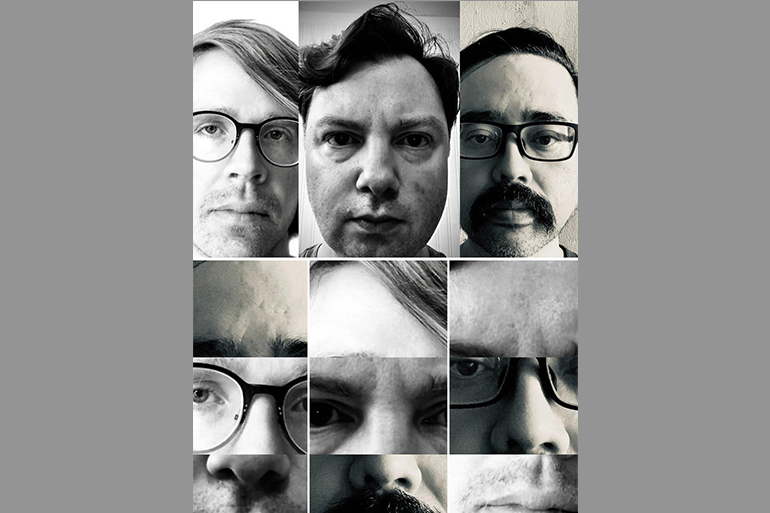
Drill for Absentee: “Everything seemed possible then (the 90s) and if we can kindle just a bit of that now, we’ll be successful”
With the release of “Strand of a Lake” about to drop, Drill for Absentee returns to the music scene with two new volumes that explore uncharted sonic territories while retaining the intensity and complexity that have always defined the band. Composed of members spread across the globe—from Okinawa to Los Angeles—the band has adapted its creative process to remote collaboration, exchanging tracks and experimenting with new approaches to songwriting.
By Sandra Pinto
In this interview, we speak with Michael and Ken about the process behind the EPs, the influence of diverse musical cultures, the impact of the “math rock” movement on a new generation of listeners, and how the band balances loyalty to its roots with sonic experimentation. They also reflect on the band’s evolution since the 1990s, the role of technology in composition, and the concept of “time travel” through music, all while paving the way for the band’s future.
Michael, you mentioned that geographic distance has influenced the way the band composed new songs. Can you tell us more about how remote collaboration worked in practice? How did exchanging tracks and digital mixing affect the sound and creativity of the band?
From a working perspective, I think the process of exchanging tracks and “consecutive collaboration” is incredibly effective, especially now that music technology makes it easy to do so. For EP 1, those 4 songs were mostly structured out when I first sent my guitar tracks to the group. From there, Ken would usually work up a rough draft of drums, which over the course of the process would sometimes change dramatically. Kevin typically introduced his bass ideas third, which would send Ken back to the drawing board and have him make edits to his initial ideas. Or, in other cases, Ken’s original ideas would spark an accompanying bass idea for Kevin. This process would eventually yield a “rough take,” and from there, we all went back and re-did our parts and worked to get the best takes possible. After this, we added vocals and layered in some additional parts. For EP 1, Kevin did make some structural edits, but they were minimal compared to the editing and reordering that he did on EP 2.
For the EP 2 process, the song creation became much more modular. Rather than delivering structured song ideas, the guitar parts were presented as building blocks: I’d present ideas as one song idea, but with the idea that the guitar parts and their order and repetitions could be edited by Kevin. In some cases, such as Styli, Kevin completely flipped the song around from its original structure. After he’d make song edits, I’d go back and record a new, rough ghost track for the guitar. All along the way, Ken would be working on drums and, once I’d have a new ghost track, the bass and drums would come together.
Of course, this working process is nothing like how a band traditionally ideates songs. Usually, even if a band member brings an idea to start with, there is a “concurrent collaboration” that begins in the moment, and the band organically evolves the original idea into a fully cohesive part, song, etc. Still, I don’t think our approach is that far afield of similar endeavors. Talk Talk’s Spirit of Eden and Laughing Stock records were produced similarly, with scores of musicians entering the studio and laying down tracks against simple ghost and bed tracks, often not knowing what the other musicians had already tracked. It was left to Mark Hollis to sort it out, and in many ways, Kevin is playing that part with us. Ultimately, he brings the final structure into focus through the mixing process.
The band has always been known for the intensity and complexity of your compositions. With this new material, do you feel that “formula” has been maintained or modified in any way? How did you balance that intensity with new musical influences?
We’ve always had a love affair with playing outside of common time and exploring polymeter and time signature overlapping. I think that our consecutive collaboration approach has allowed us to get better at doing that than we were in the 90s, and it may be the result of the approach. When we’d decide to explore those polymetric ideas in the past, we needed to “whiteboard” the ideas structurally and then come up with things to play on the spot. Now, we’re able to take our time and work things out so that the overlapping parts can be more sophisticated and developed. Great examples of these are Kevin and Ken quoting the Hums’ main verse riff in the middle section in 6, while my guitar part is in 11. You’ll find our new record dripping with ideas like these, when in the past they were more token. However, it’s exciting that we’re executing against this idea more effectively these days, because I think the polymeter ethos is something that we were always very serious about and saw it as a defining feature of our music. Creating a piece of music where the constituent parts are all playing to different time signatures is an affront to rock music — we were always very interested in owning that, to the extent that it is possible to do so. We certainly aren’t the first ones to do it — Captain Beefheart’s Trout Mask Replica forged that ground, and King Crimson’s Discipline perfected it decades before us.
The idea of being an international band with members in different parts of the world must have changed your creative dynamic. How do the different musical cultures from Okinawa, Los Angeles, and elsewhere influence each of your contributions?
We all definitely have our unique cultural inputs into the music and band. Kevin is originally from the East Coast but has lived out west for a long time now. Ken is from Japan but spent a long time studying in Hawaii and speaks English flawlessly. Probably the coolest thing about the international dynamic is that Ken communicates so well that we’ve been able to work with no barriers to communication. If it wasn’t for him putting in the work to become such an amazing English speaker, we could have probably never worked with him.
“Hums” was the first single you released, and it certainly echoes the band’s DNA with its complexities and emotional depth. How was the process of creating this track, and how does it connect with the rest of the album?
The first part I developed is actually the B section, which begins with the line, “there’s nothing between us . . .” After not having played electric guitar in a long time, a brief session reconnecting with old DFA riffs led to that part, which to me sounded a lot like something I would have come up with in the 90s. From there, the verse riff just developed of wanting to balance the fractured rhythm of that B section with something more driving. I’m sure that I was thinking of the groove in Drive Like Jehu’s “Luau.” The song (lyrics included) is supposed to be a kind of “ars musica” — an expression of the magic that comes from playing in DFA.
What made the song really come alive was when Kevin developed his bass part. In the B section, he is developing a long phrase overtop of my very short, repeating guitar part. I think this is very effective, and it makes that section of the song do more than just repeat phrases 8 times. This aesthetic established a theme that you’ll find elsewhere on the album.
With the rise of the “math rock” movement in recent years, how do you perceive its impact on the new generation of fans and the underground scene in general? Did discovering this movement on YouTube influence the creation of the new album in any way?
For me it did, because I was surprised to discover how math rock had endured, and also how it had evolved. I’ve said in other interviews that I don’t recognize a lot of the new music that gets labeled as math rock — to me, if I had to label it, I’d probably call it jazz fusion or prog rock. “Math rock” wasn’t a subgenre, a sound, or a scene; it was a characteristic of some of the underground bands playing in the post-hardcore era who simply had a love affair with time signatures and musical complexity, while often still retaining the raw energy of their punk roots. That was what I had always regarded as the “recipe” for math rock — but it’s a pretty open-ended recipe. Slint, Rodan, Crain, June of 44, Hoover, Don Caballero, Shellac, The Crownhate Ruin, Regular Watts, The Sorts, The Shipping News, Drive Like Jehu — these were our influences and, in some cases, our contemporaries. But they’re also quite different from one another. Yet, all of them comfortably feel like “math rock” to me.
Interestingly, “math rock” and “emo” have similar etymologies and histories. I believe that in WashedUp Emo’s interview with Guy Picciotto, Guy talks at length about the genesis of the term “emo;” how Brian Baker of Dag Nasty dissed Rites of Spring with that term. The “math rock” moniker is similar; emo kids would hurl that term as a diss at bands like us who they thought were trying too hard to be “complex,” just as some thought that Rites of Spring was “too emotional.” Guy goes on to talk about how surprised he is that emo has come to mean something very different in the 21st century, and very similarly, I feel the same way about math rock.
A lot of the 21st-century music that gets labeled as math rock is super impressive, and I like it. In Japan, it’s almost part of mainstream music. For our part, however, we’re trying to be stewards of the ideas and energy that were informing the math rock mindset in the 90s. For me, I’m always trying to connect with that energy.
In an era where many bands try to stay true to their roots, Drill for Absentee remains loyal to its origins, but also reinvents itself. How would you define the band’s identity today? What sets Drill for Absentee apart from other math-rock or post-hardcore bands?
Getting back into the practice of creating new music is an effort to shed light on the post-hardcore era and our scene for newer generations of listeners. Rock music has almost completely fallen out of the mainstream of music in the United States, but it is still craved by younger audiences. They’re going back into the rock music of the 90s, sifting through all of the commercial garbage, and finding the few bright spots that managed to break through and still stay true to their sound. But there’s only a limited set of those bands; avid music listeners want to go deeper and find out about all of the bands downstream of Fugazi. I’m hoping that our music will serve as an emissary to lead people back to discovering all of that great music. The music history of our scene is so rich that you can even discover completely unknown bands that were doing great things.
What do you hope the longtime fans, as well as new listeners, will take away from the experience of listening to “Strand of a Lake”? What is the message or feeling you want to convey with this album?
Most of the people from our time in the scene are Gen X’ers. I think Gen X is finally starting to look back and feel a sense of nostalgia for the unique position we hold in straddling both the pre- and post-digital ages. Part of this is reconnecting with the music. This is particularly true of people who were fortunate to tap into the unbridled creativity and passion of underground music. I hope that Strand of a Lake, Vols. 1 & 2 gives listeners from the 90s a sense that maybe some of that scene is still alive and worth listening to.
For the fans who have followed the band since the 90s, what is the main bond that connects them to the music and essence of Drill for Absentee, even with the changes in sound and composition?
In a podcast interview, Ian MacKaye was asked to characterize the punk scene, and I loved his answer: he said that the punk scene is a community that is always ready to listen to new music. I think this is what connects us to the listeners from the 90s, because that’s what we were all doing: going to DIY shows for $5 bucks, listening to a bunch of new bands, and coming away with a stack of new 7-inches. If 5 bands were playing, you knew 2 or 3 of them, but you were going to get exposed to 2-3 new bands, plus get your hands on records that you couldn’t buy anywhere else. Everything seemed possible then, and if we can kindle just a bit of that now, we’ll be successful.
Now that “Strand of a Lake” is about to be released, what does the future hold for Drill for Absentee? Are there plans for tours, new collaborations, or upcoming studio projects?
Given the success of the record, I think anything is possible, including playing live in the future. It’s not easy for us to drop everything and go do a sprawling tour, but maybe a mini tour or two could happen. Some festivals would be a great starting point. And collaborations would be great — more musicians from our era and beyond should get into the fun of trading tracks and working on songs remotely. It could spin off lots of new side projects.
As for a new studio project, I think if we write a new album, we’ll probably use the same creative process, but try to do all the final recording in a proper studio if possible. We had hoped to someday venture to Electrical Audio to record with Steve Albini before his all-too-early passing. Perhaps we’ll still end up there for the next record? We’ve just started messing around with a new idea.
Michael, you mentioned that “we’re time travelers” in relation to the album. What did you mean by that? How does the concept of time and change reflect in the songs of the new album?
I think it speaks to several things: our experimentation with time signature, our creative ventures backward and forward to the creative energy of our past as well as new ideas, and the remote nature of how we work together as a band in 2025 and beyond. You can never really go backwards in time, but music can kindle those memories and lived experiences.
Something else I wanted to mention: it’s a real pleasure to be featured in Look Magazine, as I lived in Portugal for 3 years (2013-2016). My wife is half Portuguese, and some of her family lives in Lisbon. We lived in Cascais, and while we lived there, I had the pleasure of familiarizing myself with the very cool Portuguese music scene. I discovered RADAR — perhaps the coolest radio station on the planet — and through it discovered You Can’t Win, Charlie Brown, having conversed a bit with Afonso Cabral. I also went on to work professionally with Isaura Santos, and played church music on Sundays with Toze Brito. These folks comprise some of the finest musicians I’ve ever known, and it was a pleasure to get to know them. Had I never lived in Portugal, it would have never happened.
Kevin, the band is back with a new release, “Strand of a Lake,” which will be released in two volumes. What motivated the decision to divide the album? Is there a specific reason behind each volume representing different aspects of the band?
As the project grew, and the band became more comfortable with our intercontinental workflow, the songs began to explore new territory that we hadn’t originally imagined. The songs on Volume 1 feel like an extension of the original incarnation of DFA, while the textures and soundscapes of Volume 2 move in a different creative direction.
How has the band’s sound evolved since the “Drill for Absentee” era in the 90s? What can fans expect that’s new in this work, both in terms of composition and influences?
The angular lines, bracing dissonances, and off-kilter rhythms of 90’s-era DFA are still present in these new songs, but they also feature vocal harmonies, collage-like effects, and rhythmic overlaps to a greater extent than our previously-recorded catalog.
Volume 2 seems to mark a transition to a more expansive and progressive sound. How was the process of exploring these new musical territories? Was it a challenge or something that happened naturally?
I think some of it was a result of the recording process. Since we were all recording separately in our own spaces, and I was mixing everything together in my home studio in LA, we were able to experiment in ways that may not have been otherwise possible. A song like 7riangles features rhythmic relationships that would have been very hard to pull off in a more traditional recording environment.
Kevin, you’ve always mentioned that the band is heavily influenced by the experiences you’ve lived and the various projects you’ve been part of. How are these influences reflected in the new album, especially in your work alongside other musicians over the years?
My creative output since the early 2000’s has largely centered around contemporary classical music and stripped-down indie folk. Some of the vocal layers in Desert Flame are reminiscent of my band Homesick Elephant, while the sound-worlds of a song like Skating, or the closing section of Styli, owe something to my work as a composer. I also think my lyrics have evolved quite a bit. I tried to recapture some of the abstract nature of my 90’s lyrics in the new songs, but some of my current preoccupations with time, meaning, and mortality work their way into the writing. I was just a kid when DFA was originally active! Now I’m a mid-forties husband and father with entirely different concerns and a much broader worldview.
Kevin, you mentioned that the new album reflects a wide range of influences. What were some of the most unexpected or surprising influences throughout the composition process?
For me, I think the most unexpected influences were derived from my experiences working with digital sound-shaping in creating film scores. The recording aesthetic of Drill for Absentee was always guided by the attempt to capture the live energy of the band; recording remotely allowed me to experiment with interesting digital effects and incorporate them into the band’s core sound. You can hear this most clearly in Skating, where I sampled bits of Michael’s voice and created a playable synth out of them.
Now that “Strand of a Lake” is about to be released, what does the future hold for Drill for Absentee? Are there plans for tours, new collaborations, or upcoming studio projects?
While we don’t currently have any live performance planned, I am hopeful that we will be able to put together these songs and play some shows. I would love to play in Japan, which I’ve never had the opportunity to do, and it would be so great to finally meet Ken in person! Some ideas for a new batch of songs are already floating around, so we’ll see what the future holds.
First off, I am honored that Drill For Absentee is to be featured in Look Magazine. I myself have a Portuguese connection through my relatives who had immigrated to Brazil and their children’s first language is Portuguese. Also, I attended college in Hawaii which has a large population of Portuguese descendants, who once inhabited the island of Azores and made way to Hawaii. Quite a few of them were heavily involved in the Hawaii punk scene.
I’ve been playing in bands making original music for the most part for the past 30 years so routinely playing covers is a recent thing. When the COVID pandemic hit in 2020, I couldn’t practice with my band let alone play shows, so I needed to do something to “sharpen the saw” with my drumming. That’s how the drum covers started. I re-visited the songs I loved (mainly old 80s – 90s punk/hardcore), played them by year and uploaded them on social media. By the 100th cover, I was getting responses from not only the heavy punk listeners but also the band members themselves whose songs I covered. In October 2021, I received a DM from Mike that he saw my June of 44 cover and asked whether I was interested in recording a drum track for Drill For Absentee. I didn’t think I was qualified to be their drummer but as we exchanged individual tracks did rough overdubs, I slowly got the hang of remote songwriting and recording, that after tackling one song (“Hums” the opening track of Strand of a Lake Vol. 1) we started working on another one, then another one, eventually growing into a double-EP.
As I self-taught drummer for the most part (I took a few drum lessons when I first started playing in high school), doing covers is the most fun way to learn. Like any other drummer, I’ve always “stole” bits of ideas from others and incorporated them into my original songs but playing close to 300 covers from start to finish really helped me with DFA’s songs. When Mike and Kevin programmed the drums on the demo tracks (some were extremely intricate), I would thoroughly learn them first and try to make improvements. After going back and forth with track exchanges and overdubs, some of the songs turned out to be nothing like the initial demos.
I feel that I represent many punk bands who were active in college but never accomplished much, like say, make a record or go on extensive tours. That was my biggest regret of not going “all in” when I could have. Now in my late 40s, I never imagined being able to embark in this musical journey with DFA and I feel now that I indeed realized my “American Dream” of releasing a record. Ideally, I would like to record in a studio together with the band and play some shows, but we shall see.
As for how Okinawan culture’s role in the creative process, Okinawa is pretty complicated. It is a tiny island in the Pacific Ocean, sandwiched between mainland Japan and China, with houses 70 percent of the United States military forces in Japan. I had the rather unique opportunity of going to an international school and being exposed to American culture more than the average Okinawan or Japanese. Personally speaking, if I hadn’t had this experience, it’d never have occurred to me to even attempt to record with Drill For Absentee. This has never been done, and I don’t expect anyone else on this tiny island to do the same in the foreseeable future. That is why this release is so significant – many pieces involved, not just the recording but the artwork and working with the label, Expert Work Records.