Absence of Colors: “We like to explore different musical aesthetics, and we fully embrace the idea of writing compositions driven by curiosity”
Suspended between shadow and light, weight and contemplation, Absence of Colors crafts a distinctive musical language where post-metal intensity meets experimentation and sensory depth. Formed in 2022, the band explores the idea of absence, of colour, certainty, and even meaning, as a creative force, shaping music that is immersive, hypnotic, and deeply cinematic. Blending unconventional structures, digital arts, and technology with a strong focus on live performance, Absence of Colors resists easy categorisation in favour of artistic freedom and emotional authenticity. Their album Poison on Your Lips unfolds as a journey through tension, collapse, and resilience, where crushing heaviness coexists with fragile, atmospheric beauty.
By Sandra Pinto
In this interview, the band reflects on the origins of their evocative name, their creative process, the role of experimentation, the balance between brutality and poetry, and how complex inner narratives are transformed into powerful sonic experiences — both on record and on stage.
Absence of Colors is a very evocative name. What does it represent for you as a band, both musically and emotionally?
This name is evocative while remaining open to interpretation. It can be perceived as a form of melancholy, like a black-and-white photograph. It also suggests fragility — a sense of absence or lack.
The original idea behind the project was to create a black-and-white live performance and to question the relationship between music and light. I want this name to evoke depth and beauty, while also carrying something absurd, even dystopian. Absence of Colors represents a loss of meaning, and it also echoes the film Perfect Sense, in which the characters lose their five senses one by one and eventually fall into madness. Even though everything is tinged with darkness, our desire is to write music that opens toward something brighter.
You formed in 2022: how did the band come together, and what creative urgency drove you to start this project?
We first started as a duo with Damien on drums. We had already been collaborating for several years on other projects — I was often the sound engineer on the bands he played in. One day, we thought it would be great to start a project together around rock music, while also developing an approach connected to digital arts. From the very beginning, we worked on lights and interactions with our instruments. We
went through a long “geek phase,” developing augmented instruments: an acoustic drum kit equipped with sensors to trigger samples, synths and lights, complex loopers to record multiple guitar layers live…
Once we understood the potential of these tools, we began composing the music and the lighting almost simultaneously — you could say they were written on the same score. Everything came together quite quickly after that: we created a one-hour live set and released our first record at the same time, in autumn 2022.
Being a relatively young band, how do you define your identity within the post-metal and experimental scenes today?
This is an interesting question, but not an easy one to answer 🙂 Our main goal is to preserve a sense of uniqueness and to avoid conforming our music to make it more accessible. We like to explore different musical aesthetics, and we fully embrace the idea of writing compositions driven by curiosity. Labels and genre definitions matter very little to me — they often feel like an oversimplification. I think I prefer mentioning our influences instead, because it gives a clearer idea of our musical tastes and where our work comes from. So here’s a bit of name-dropping, just to cite a few fully-assumed influences: Cult of Luna, Pelican, Deftones, Tool, Candiria, Meshuggah…
“Poison on Your Lips” feels like a very strong and intimate title. What does it symbolise, and how does it relate to the album’s emotional core?
I’m glad you perceive this track that way. To me, it means many things at once — from the most intimate to the most explicit. It’s connected to our latest creative phase, which you can find on the first side of our vinyl.
It comes from a visceral worry: sometimes the thing that is most precious to you can also destroy you. It all begins with an awareness and the discovery of a tragedy (Ignorance Is Strength). You’re utterly shaken to your core, and you don’t even know how you’re still standing. But after a period of shock, you feel a force within you — a tremendous force that allows you to keep breathing despite everything, despite the feeling of suffocation (The Hidden Giant).
Finally comes the need to react, to explode, the need for an escape to start moving forward and continue the flow of your life (Fury Room). It’s a journey of resilience, with its labyrinths, doubts, and bursts of rage…
Was there a central concept or narrative guiding the album, or did it emerge more organically during the writing process?
I think I’ve already more or less answered this question earlier regarding the central narrative. I wouldn’t call it a concept, though, because it wasn’t designed as such. Things just came together in a surprisingly cohesive way, converging at the same time and place.
The first three tracks are very closely linked because they were composed simultaneously. The other two (Perfect Storm and Death From Above) come more from the period of our first EP, Cycles. The concept of Cycles was about the patterns humanity repeats and exposing the carnage it causes on this earth. Each track reflects a major historical mistake, particularly highlighting the excesses of capitalism…
Although all this is very dark, the main question is how we can navigate these challenges, free ourselves, react and break away.
The album often feels like a ritual or a journey. Was that sense of progression intentional from the start?
It may be because there is very little repetition in our tracks. We often move from point A to point B without ever going back. Maybe it’s a way of not letting the past overwhelm us 😉
There’s nothing particularly deliberate or conscious about this approach to composition, apart from our desire to explore this path — using original, non-conventional structures. I’d say I tend to compose a lot in “puzzle mode,” and then I think about how everything fits together.
Sometimes I end up with a blend of three different pieces that eventually form a single whole — Death From Above, for example.
Your music moves between restraint and explosive release. How conscious are you of this tension when composing?
I feel like the ultimate goal of what we write is to converge toward a climax — the final point where the track truly unfolds. Our music is riff-based, and when we find something explosive, heavy, and compelling, we try to retrace the story that will lead to that explosion.
So yes, it’s a conscious process, even if our control over the final result is sometimes rather approximate!
As a primarily instrumental band, how do you communicate emotion and meaning without words?
Personally, I listen to a lot of instrumental music, so we really try to do our best to make our tracks engaging, even without vocals. We aim for music that’s both simple and distinctive, while drawing inspiration from more sophisticated traditions like jazz or classical.
Promoting instrumental music is definitely a challenge — even in the metal scene, which is often seen as wild and unrestrained. And even when you talk about “extreme music,” you still feel a lot of standardisation. I really admire bands that pursue an uncompromising vision and aren’t afraid to step off the beaten path. They redefine how music can be written, without worrying about commercial or popular appeal. I think our music is open enough for everyone to find their own meaning, often tied to the track titles. “Fury Room” is probably our most expressive track when it comes to journey or ritual — we try to give listeners multiple ways to connect, so it resonates with different sensibilities. And if someone calls us Alt Rock, I’m sure they’ll really enjoy “Perfect Storm,” for example! We don’t feel any particular constraint, and we have no hesitation in standing behind our music. We simply want to surprise, unsettle, soothe, hypnotise — all of this with
enthusiasm and passion.
You embrace unconventional structures and electronic experimentation. What role does experimentation play in your creative process?
For us, music is, above all, an infinite playground. We chose the label “post-metal” just as a rough way to summarise what we do. We love spending time experimenting with new ways of composing or playing. Sometimes we spend entire days just testing things with our tools, software, and instruments, without actually composing anything — a bit like geeks or programmers.
We also spend a lot of time simply writing music, jamming together, and creating material without worrying too much about technique. But we always keep in mind that we’re going to perform these compositions live, which naturally adds some constraints. In fact, each track usually comes with its own set of limitations, which helps give structure to our compositions, because otherwise we could go in any direction.
Take The Hidden Giant, for example. Without even talking about the story it tells, one of the constraints was to set the time signature to 4/4, keep a steady tempo, and only use 16-bar cycles. Each new cycle introduces a development. The track is built on this foundation, even if the ending — and actually the intro too, haha — breaks the original rule a bit. At first glance, it might seem very standard, but since most of our other compositions aren’t in 4/4 or based on 16-bar cycles, it really stands out! So we try to juggle between these phases, keeping what feels good and distinctive.
Which influences , musical or non-musical, were most present while writing this album?
At first glance, I’d say we were looking for a sound, a heaviness, and a distinctiveness that you can find in bands like Meshuggah, Tool, Deftones, Machine Head, or Soulfly, to name just a few. Not necessarily in their most recent albums, since these are deeply rooted influences. We were mostly inspired by their sonic signatures, which pushed us to tune very low to achieve the heaviness that was missing in our first EP. I think we drew inspiration from that imprint while still forging our own path.
Films or series, like Black Mirror for example, inspire themes that we explore in our tracks. We also draw inspiration from dystopian books (Orwell, Damasio, etc.), which offer a dark and absurd vision of our world and help us reflect on current political, economic, ecological, and social issues.
The album balances harshness with poetry. How important is atmosphere compared to heaviness in your sound?
Thank you for that comment — this balance feels very important to us, just as important as sharpening our critical thinking without becoming needlessly negative. We often come to the bitter realization that we live in an “unfair world,” but we don’t want to fall into a kind of complaint that drags everything downward. It’s a mindset we try to uphold both in the way we make music and in the way we live.
We often start from the darker side of our stories and move toward something that opens up, that questions, that struggles in order to rise above. We’re constantly searching for that contrast — the heaviness of certain riffs would mean nothing without a more atmospheric, contemplative, almost luminous counterpoint. Sometimes it’s those few seconds that precede a particularly “heavy” riff that allow the track to burst forward with a kind of liberating energy.
Many listeners describe your music as hypnotic. Is trance or repetition something you actively seek to create?
We don’t really have much distance from this new album yet, but in any case, we’re trying to capture people’s attention through it. There’s something almost more autistic than hypnotic about it. Certain extremely simple melodies (ostinatos, perhaps?) allow us to build density around a simple, repetitive idea. It’s quite unsettling to experience these tracks live, and we try to keep that finality in mind while writing them. In any case, this state of swaying, of repetition, has been part of our musical vocabulary for quite some time.
“Poison on Your Lips” seems poised between collapse and rebirth. Do you see the album as a reflection of inner struggle or transformation?
I really like the way you experience this album 🙂 We write things spontaneously, without systematically intellectualizing our actions. Music flows through our lives, no matter what happens along the way. At some point, we’re ready to share a work that began many years earlier.
Even though I’m very fond of the dystopian idea of collapse and rebirth from a poetic standpoint, I’d say that, in hindsight, what best sums up this album is resilience — the ability to get back up and keep going…
How do you translate such a dense and atmospheric album into a live setting?
I think this is one of the most fun parts to approach! As I mentioned earlier, we write music that’s crafted for live performance. We don’t hesitate to change structures if needed, and we tend to be more expansive on stage. We often extend parts that feel too short in a live context.
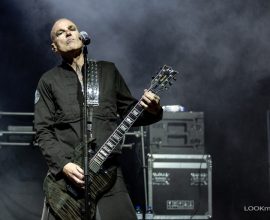
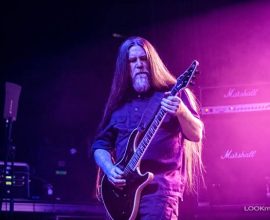
Early on in the project, we defined the performer roles we would each take on. Damien (drums) handles the acoustic drums as well as all the electronic samples, textures, etc. He uses optical sensors on his kit that allow him to trigger a whole range of sounds depending on the part of the track. Sometimes he even plays guitar riff parts with his bass drum!
Brice is our newest member and takes care of everything that makes the ground shake — bass and analog synth bass. He’s our backbone and the one who changes his sonic timbre the least.
As for me, I use a wide variety of sounds per track and layer guitar loops that form complete arrangements, or create textures, drones, and sonic atmospheres. I cover a broad spectrum to bring the airy and hypnotic side. We have a lot of fun creating contrasts between very raw, power-trio moments and others that feel like we’re playing as a full ensemble!
What do you hope listeners feel or experience when hearing this album for the first time?
I hope they’ll have the opportunity to listen to it really loud, from start to finish! And then, I hope they can create their own story and take the time to journey through these tracks with vivid images in their mind.
I always hope that my music can reach them deeply, fill them with energy, make them cry… make people feel the same way I feel when I listen to music that immerses me into my thoughts and sensations, even if I can’t necessarily put it into words. I remember a fortuitous “experience” I had when I was 20. I had taken some illicit substances and locked myself in a tent under the sun, listening to Chaosphere by Meshuggah, from start to finish… very, very loud. I even listened to the last glitch that loops over and over. I came out of the tent completely shaken, as if I had just gone through an initiation ritual… and I had just discovered this band. I wasn’t the same person anymore — I had just received a huge sonic blow, and I felt completely elastic…
Now that the album is released via Weird Noise on LP and digital, what are the next steps for Absence of Colors?
We’re very happy with the response to the album, and we’re currently working on booking shows at full throttle so we can take it to the stage and defend it live. We’ve already started composing new material and we’re really excited about writing more as a trio. But for now, the priority is to tour as much as possible and share our music with as many people as we can!