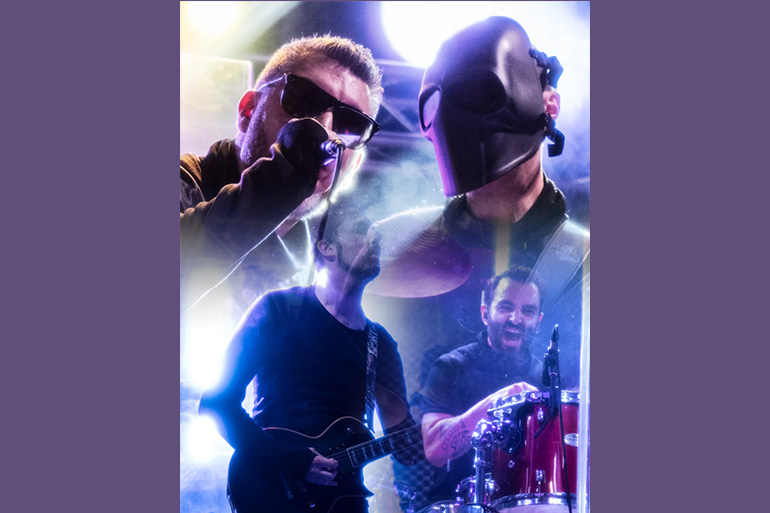
“The dynamics of the vocal lines are essential to convey a story like this”, Vanderlust
“The Human Farm” presents a dystopian universe where comfort and protection come at the cost of freedom. In this interview, we explore with the band Vanderlust the inspiration behind this moral dilemma, the narrative construction of the concept album, and how sci-fi elements intertwine with progressive metal to create an engaging musical experience. We discuss the journey of the protagonist Abe, the approach to composition and vocal interpretation, as well as the challenges of turning an ambitious story into cohesive music.
By Sandra Pinto
Between literary and cinematic influences and the evolution of the band’s sound, this conversation offers a deep insight into the complex and fascinating world of “The Human Farm.”
The Human Farm revolves around a dystopian premise: protection and comfort in exchange for freedom and life. What inspired you to explore this moral dilemma within a sci-fi context?
The idea for the story comes from the question “If I lived my life like a farm animal, would itbe entirely a negative thing? Or could the comfort and protection that farm animals enjoysomehow compensate for the lack of freedom?”. From there, we developed the story and tried to imagine a world like the one described in the concept album. The band Vanderlust was also created to tell sci-fi stories, so we tried to
imagine the narrative within a similar kind of setting.
How does the story of the protagonist, Abe, connect to universal themes of freedom, conformity, and personal responsibility?
Abe is a metaphor for Abraham in the Bible (the name Abe derives from his). He tries to lead some people away to a new “land of Canaan”, escaping from a kind of slavery. He represents the metaphor of a leader who wants freedom for his people, but he is also torn by deep existential dilemmas (“Am I really doing the right thing? What if the freedom we are chasing isn’t what we imagine it to be?”).
Each track functions as part of a continuous narrative. What was the biggest challenge in balancing storytelling with musical coherence in such an ambitious concept album?
The biggest challenge at the beginning was connecting some musical ideas we had composed before writing the story. We tried to divide the story into chapters and imagine the mood of each one, matching them with the musical ideas that suited them best. The rest was composed later, adapting it to the chapters of the story.
This single marks the first decisive “fracture” in the narrative. Can you explain how the music reflects this dramatic turning point in the story?
“Humanity 2.0 – The Human Farm” works as a prologue and introduction to the story. With “Golden Shackles”, the actual narrative begins: through its dynamism and impact, the song describes the current state and the world in which the characters live. That’s where Abe’s reflection on freedom begins. It will be with “The Turning Point” that the rebels start planning their escape. This last track has a progressive structure precisely to describe the transition from a simple idea to a concrete action.
The vocals are described as dramatic with a power-oriented cadence. How did you approach vocal interpretation to enhance tension and thematic weight?
The dynamics of the vocal lines are essential to convey a story like this. Riccardo also has a lot of experience in musical theatre, and his approach to composing and performing the vocal lines is certainly enriched by this important background.
The track balances precise riffs with futuristic harmonic layers. What was your composition process for integrating progressive technique with melodic accessibility?
Our background of listening and previous songwriting experiences certainly helps a lot. In any case, it’s also a kind of artistic balance between us as musicians. The contrast between a more prog-oriented way of playing and a more power/dramatic vocal style comes precisely from the blend of our musical influences.
Compared to your debut album, The Human Farm shows clear growth in progressive complexity and orchestral/electronic textures. Which musical elements were the most challenging to develop?
Certainly, the most important new elements are the electronic and keyboard parts, along with a stronger emphasis on symphonic elements, which were also present on the first album but to a lesser extent. The biggest challenge was trying to make our sound a bit more modern and personal, moving away from that classic metal style we inevitably come from, and that has been heard many times before.
How do the futuristic instrumentation and orchestral layers help reinforce the sci-fi setting without overwhelming the intensity of the metal?
Certainly, there are many bands that inspired us in this regard, bands like Dream Theater, Andromeda, Therion, and others. Nowadays, more modern metal productions are often enriched with elements like these without losing their impact. Learning from the masters has definitely been a great help.
Do you see “Golden Shackles” as an entry point for the album, or more as a central hinge that guides the overall narrative?
I think “Golden Shackles” is more of an entry point for the album.
Francesco Romeggini is described as the driving force behind the album’s musical architecture. How does the band’s composition process work, and how do narrative ideas influence riffs and arrangements?
The songs are written by me (Francesco, the guitarist) and arranged together with the rest of the band. It’s a team effort where we all contribute our ideas, and I lead the process. I tried to write sci-fi oriented riffs to get that mood, asking myself “what do I want to tell with this
song?”.
How do you balance technical precision and emotional impact to create music that is both complex and engaging for listeners?
In progressive metal, it’s always very difficult to find this balance; perhaps we aren’t exactly a progressive band, we prefer to define ourselves simply as "cosmic metal". In any case, it’s a way of composing that comes fairly naturally to us.
Sci-fi is a central element of the band’s identity. Which authors, films, or works inspired the universe of The Human Farm?
You can find similarities with “Matrix”, “1984”, there’s also connections with “The Allegory of the cave” and “The Bible”, and of course … The most important: The history of human society itself.
What kind of experience do you hope listeners will have when hearing “Golden Shackles” and the full album?
“Golden Shackles” is energetic and explosive; it’;s a great preview of our style, showcasing our most energetic and catchy side. The rest of the album follows this mood to some extent, while also exploring darker and more introspective moments. Our hope is that those who listen to this album experience it as a journey to be taken in full and understand the story’s meaning through the music.
For new listeners who haven’t heard Vanderlust before, how would you summarize the band’s identity and what sets it apart in progressive metal?
Compared to canonical prog metal bands, we focus less on instrumental virtuosity; the solo sections are fewer, and the songs are shorter in length. What connects us to that genre is more a pursuit of underlying compositional elegance. In certain aspects, we are closer to power metal.
Are there plans to perform The Human Farm live? How do you plan to translate such a dense concept album to the stage?
Sure, after the album release we’ll play in some local shows. We try to replicate live what you can hear on the album, in the most faithful way possible. Join our cosmic journey!
Facebook here