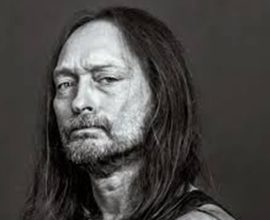
“Some ideas need to sit in a jar on a shelf for a few weeks until they can be further processed”, ZAHN
With their latest release Purpur, ZAHN takes listeners on a bold and immersive journey through dense, hypnotic soundscapes that blend rock, electronic textures, Krautrock, Dark Jazz, Noise Rock, and Post-Punk. Felix Gebhard, speaking for the trio, explains how Purpur represents the band’s evolutionary process — a careful balance between experimentation and the mastery of their craft — while maintaining a signature intensity and subterranean depth. The album’s intricate arrangements, collaborations with guest musicians, and striking visual aesthetic all reflect ZAHN’s collective creative ethos: music that ferments, evolves, and challenges conventional boundaries.
By Sandra Pinto
For newcomers and long-time fans alike, Purpur promises an experience that is as sensory and emotional as it is physically compelling — a record meant to be felt, absorbed, and explored in full immersion.
Purpur has been described as your boldest album yet. How would you define this evolution compared to your previous work?
Some things take a while to be fully figured out. In ZAHNs case this means that certain techniques and the knowledge and confidence to use them have to grow over a longer period to then be fully implemented in ZAHNs creative process. The work on each album comes with its own learning curve, new tools, new colors, a new set of mind(s). It’s an evolutionary process and at the risk of sounding cocky I would like to state: With each album we’re getting better at what we’re doing.
The album blends rock and electronic elements in a very intense way. What was the starting point for finding that balance between synthetic and organic sounds?
Rather than a precise starting point there has been a long process of elements seeping in and out. Tools and instruments were found on the way and added to the band’s palette. The balance forms after what a particular song requires.
The title Purpur and the cover art are full of color and fruit references. How does the visual aesthetic connect to the music on the album?The visual aesthetic and concept around that and the album’s song titles are an important factor that may or may not make sense to anyone outside the band’s inner life. However, by putting it out into the world as a piece of art we can claim that there is indeed a direct connection between the product’s acoustic and visual factors and from that moment on everyone has to agree that this connection exists.
You’ve described the record as “fermented” rather than composed. What does this mean for your creative process as a trio?
.
Magnus Lindberg mixed and mastered the album. How did his approach influence the final result and the album’s dense sonic texture?
We had worked with Mr Lindberg before because we love his work, and since that previous cooperation was a very fruitful one, we wanted to go for it again. To quote Alf Ramsey: ”Never change a winning team”!
You worked again with Peter Voigtmann in the studio. What is the recording and production dynamic like with him?
Peter Voigtmann is one of several honorary members of the band ZAHN. There’s been establshed a, for lack of better words, hive-mindesque way of communication between these individuals, not many words are needed on the way to achieving excellent results.
The sound of the album is intricate, dense, and almost hypnotic. What techniques or instruments helped create that “subterranean depth”?
The main factor in creating the album’s sound is indeed the high quality of Northern Germany’s surviving network of atomic energy which feeds directly into the power hub of Peter Voigtmann’s studio ”Die Mühle”. While the whole world turns to ”alternative” power and regenerative energy, the best-sounding results when using tube-driven power amps, are still achieved by using good old nuclear power.
The album features guest appearances from Fabian Bremer and Kjetil Nernes. How did these collaborations come about, and how did they shape the final tracks?
Fabian Bremer is another well-established honorary member with many years of service in the world of ZAHN, both in the visual and the musical department. It has become a so-called no-brainer to have him sprinkle his magic over ZAHNs music. Kjetil Nernes has appeared on the verge of ZAHNs cosmos a while ago and has been nominated junior honorary member as a result of this recent contribution. We all couldn’t be happier about having him on board and are looking forward to a fruitful and exciting common future.
Purpur draws on Krautrock, Dark Jazz, Noise Rock, and Post-Punk. What were the main influences that shaped this record?
Rather than listing more genres here I would like to think that the key to Purpur is immersing oneself into the collective process of coming up with interesting music.
There’s a strong sense of danger and intensity in the sound. What personal experiences or emotions inspired these atmospheres?
A certain sense of frustration about not being eloquent enough to be able to in a profound and useful way add to turning around the current global shit show, ZAHN instead tries to shift focus and help to let loose, if only for the duration of a show or a record’s length. Danger and intensity appear by themselves.
How would you describe ZAHN’s sound in three words to someone who’s never heard you before?
Chris, Nic, Felix.
After three albums, how do you balance innovation and consistency while maintaining your musical identity?
If ZAHN has a musical identity it is defined by the will to try new things and not go the path well traveled. The consistency, if there is one, exists by digging into the numerous tool boxes available to ZAHN. There is no particular worry about how to balance these things.
What kind of experience do you want listeners to have with Purpur — is it emotional, physical, or purely sensory?
It can be any of the above. In a perfect scenario listeners are enjoying Purpur through a high-quality sound system at rather high volume in a room of at least 20 square meters. That way any emotional or physical experience will materialize by itself.
For new and long-time fans alike, what message or feeling do you hope the album leaves behind?
”The music don’t feel like it did when I felt it with you.” Womack & Womack