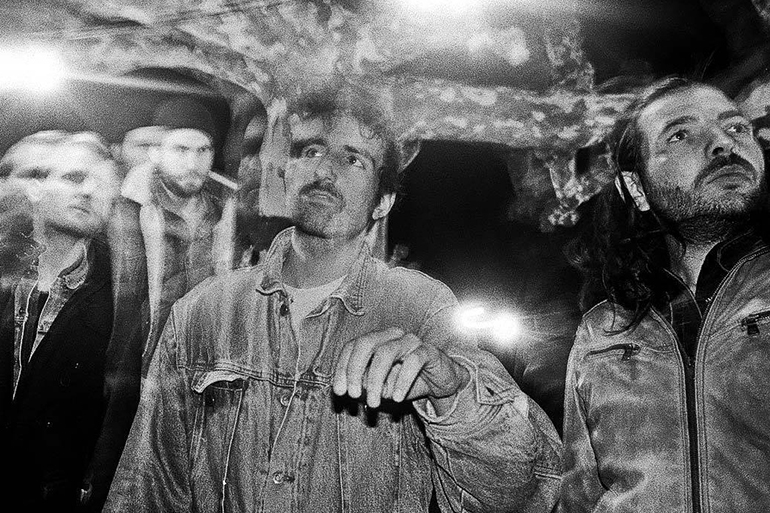
“We used to jam a lot and record everything”, Harvey Rushmore & the Octopus
Harvey Rushmore & the Octopus returns with Mindsuckers, a record that balances dystopian intensity with dreamy introspection. At the heart of the new album is Cloud Driver, a personal and melancholic track that contrasts with the band’s more frenetic garage and psychedelic elements. In this interview, Massimo Tondini, the band’s songwriter, vocalist, and guitarist, shares insights into the creative process behind the album, the inspiration drawn from personal experiences and societal turbulence, and the ways the band fuses structured songwriting with improvisational experimentation. From ethereal soundscapes to hallucinatory live energy, Harvey Rushmore & the Octopus continues to explore emotional depth and sonic texture, offering listeners a journey that is as immersive as it is intense.
By Sandra Pinto
For newcomers, Mindsuckers promises an experience that’s part dystopian odyssey, part reflective escape — a delicate balance of chaos and calm that defines the band’s evolving sound.
How did Cloud Driver come about, and what role does it play in the overall concept of Mindsuckers?
It’s a very personal song about a love that couldn’t happen because of difficult circumstances. For me, it became a way to process intense emotions, using an abstract, poetic concept rather than addressing them directly. The core metaphor is a palace built too close to the sun: something that feels bright and fulfilling at first, but simply can’t survive in the long run.
Musically, the track creates a dreamy, melancholic atmosphere. It’s driven by a slow, minimal beat and repetitive chord changes that pull you deeper and deeper into the mood. This makes it a calm, profound counterpart to the faster garage tracks on the album, which is also why the song holds such personal significance for me.
With Harvey Rushmore & the Octopus, we’ve always experimented with contrasting moods and styles. This song is a good example of how far we like to explore emotional and atmospheric spaces.
After last year’s high-energy European tour for Freedomspacecake, how was the creative pause that led to this new single?
We focused on developing new material and gave ourselves the time and space to really engage with the creative process. During that period, we were also dealing with some major life changes and personal shifts: our bass player became a father, our keyboard player was active in other bands, and I was navigating a very demanding job. On top of that, we moved our rehearsal space. All of this pushed us to rethink how we work together. We had less time and needed to find a new approach. We became much more digitally connected, sharing demos through the cloud and working on ideas simultaneously from different locations. For me personally, planned creative breaks were essential. Moments where I could fully concentrate on songwriting and immerse myself in a specific mood. One of those breaks was a trip to Normandy, which ultimately inspired the song Acid River.
Mindsuckers is described as darker and more focused compared to Freedomspacecake. How would you define this new phase of the band?
I definitely felt a growing sense of urgency in how I perceived the global political situation, the rapid technological developments around AI, and the social issues that are becoming more intense. That atmosphere became a major source of inspiration for us. We tried to process our fears and dystopian thoughts, give them a shape, and integrate them into our music.
You often incorporate psychedelic improvisation and garage rock elements. How do you balance spontaneity with structured songwriting?
We used to jam a lot and record everything. Afterwards, we listened back over and over again to find the moments that stood out. Those fragments often became the foundation for new songs. This approach opened the door to unexpected ideas, blending free improvisation with structured songwriting. Of course, it didn’t always work. Sometimes a jam felt so good in its original form that trying to turn it into a song never led us back to that same magic. For this album, we wanted to shift the focus more toward songwriting itself. We deliberately cut back on long guitar solos to explore new musical ideas and see where a more concise approach would take us.
What musical or non-musical influences inspired the sound and mood of Cloud Driver and Mindsuckers?
Cloud Driver was inspired by the sound of a Roland SA‑09 Saturn, which created that smooth, dreamy bed of chords and set a mellow overall mood. Having this texture on the demo, paired with a slow and steady beat, opened up an atmospheric space where the whole idea could take shape and grow naturally. The song Mindsucker on the other hand, came from a much more chaotic and dramatic moment: watching David Cronenberg’s Scanners with some friends while being stoned. The whole experience felt bizarre, unsettling, exaggerated, and somehow hilarious at the same time, and I wanted to capture that strange mix in a song. Our drummer sent me a beautifully modified beat. I blended it with a few loops from the film’s soundtrack, tuned my guitar down, and suddenly the riff just appeared out of nowhere. There’s something special about building the atmosphere first and letting the ideas emerge from within it.
The song explores interpersonal illusions and the fading of intense emotions. Are there personal experiences or observations that inspired these lyrics?
At that time, I was practicing a lot of mindfulness, which made me realize how overwhelmed we are by unnecessary information and constant bad, menacing news. It felt like an uncontrollable force feeding us unhealthy impulses, always trying to hijack our attention and shape our thoughts. That’s when the idea came up to give this force a trashy, almost cartoonlike name and place it inside our Harvey universe. We started calling them the Mindsuckers.
You aim to convey a specific emotional experience to listeners. How do you hope Cloud Driver resonates with your audience?
I’d love for people to enjoy the song and feel good while listening to it. Ideally in a special place, with special people. I’m really happy that a few of the songs have the potential to calm you down and make you feel comfortable, especially since most of our music doesn’t usually head in that direction.
How does the concept of Mindsuckers — venturing into dystopian territory — connect with the emotional or societal turbulence of the present day?
Mindsuckers taps into today’s sense of overload. Political tension, constant alarm signals, and a flood of images and stimuli pulling you into a constant state of alert. A never‑ending stream of menacing news that paints an increasingly dystopian vision of our future. The idea was to give an exaggerated face to those very real forces that try to hijack your attention and manipulate your thinking. We call these creatures Mindsuckers and place them in our own B‑movie fantasy universe. It’s our way of processing the heaviness of the times while still holding on to playfulness and joy.
The single gives a glimpse of the album’s direction. Will there be a tour to support Mindsuckers?
Absolutely. We’re excited to play more shows. We’re planning several concerts in Switzerland, and we’re currently working on a broader European tour that will take us to Germany, Poland, the Czech Republic, and Lithuania. Harvey Rushmore & the Octopus has always been a band shaped by live performances, and playing on stage remains an important part of how we develop our music.
Do you plan to explore even more psychedelic improvisation during live performances of the new material?
Yes, the new album includes several songs that give us room to experiment and explore new variations. Cosmic Waves i.e. is especially trippy and really thrives on a vibrant, unpredictable energy that lets us react spontaneously to the crowd and the atmosphere in the room. We’ll also bring back some older tracks that blend structured songwriting with moments of live improvisation.
For someone who hasn’t heard Harvey Rushmore & the Octopus before, how would you describe the experience of listening to Cloud Driver and Mindsuckers?
Mindsuckers feels like wandering through a dark, dystopian city pulsing with restless energy. Loud drums, swirling noise and hypnotic patterns pull you deeper into a hallucinatory universe, filled with echoes of the unsettling world we’re living in. The combination of drum machine and wild, human drumming creates a physical force that grabs you and makes your body respond. It’s raw, immediate, and right in your face.
Cloud Driver on the other hand, opens up space. It lifts you from that heavy ground and lets you drift: dreamy, melancholic, yet carrying a quiet sense of optimism. It’s like a counterweight in a constantly shifting universe, offering a moment to float, breathe, and lose yourself in something lighter.
Is there a standout moment from recording or writing Cloud Driver that sticks with you?
It was a great feeling to dive into guitar feedback experiments in the studio. It wasn’t just about playing in the usual way, but about physically moving the guitar with a lot of fuzz in front of the amp, listening to what kind of noise would emerge and how it could find its place in the music. I’m really happy with the result, and it was a lot of fun to explore those textures. Jari, our producer, was the perfect person to guide this process, he’s a true master when it comes to delivering musicality out of feedback.
The band has always been known for an intense, ethereal sound. Were there any new techniques, instruments, or approaches that shaped this album?
This time we tried to focus more on songwriting and to step back a bit from the long, repetitive guitar‑solo vibe of our earlier records. I also spent a lot of time working on my voice and even started taking singing lessons, which helped me discover new colours and textures I hadn’t noticed before. I think you can hear that on the album, there’s a more deliberate vocal presence, and the songs feel more complete while still keeping that hazy, immersive energy we’re known for.