“We still love what we do, and we believe in it”, Bottle Next
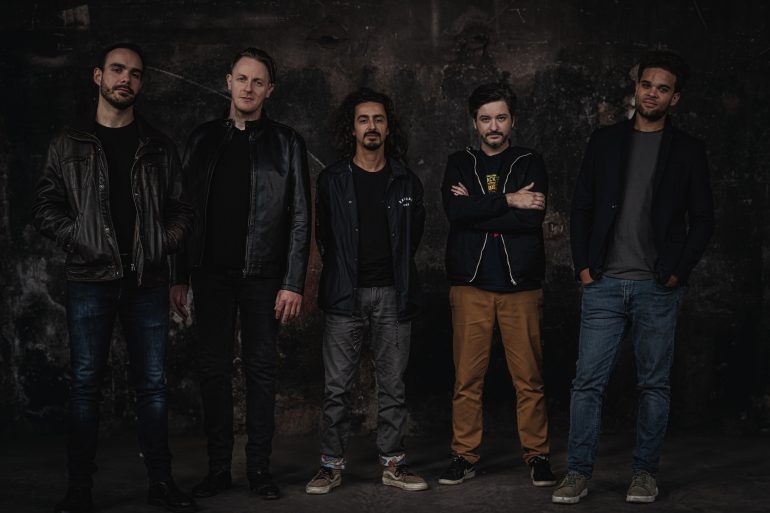
After 15 years of exploration and evolution, Bottle Next has undergone a complete metamorphosis. From a duo experimenting with rock’n’roll ideas to a fully-fledged quintet, the band has embraced new possibilities while keeping their signature intensity and melodic sensibility. In this interview, we explore the artistic and practical reasons behind this transformation, the concept of “elegance” in their 2026 sound, and how tracks like Half Wit blend industrial tension with hooks that are both confrontational and accessible. The discussion also touches on lyrical themes, creative processes, and the live energy that drives their music, offering insight into how Bottle Next continues to push boundaries while remaining authentic to their vision.
By Sandra Pinto
For listeners encountering them for the first time, Bottle Next promises alternative rock that is powerful, melodic, and built on over a decade of experimentation — a band that balances raw aggression with precision, personality, and thoughtful composition.
After 15 years of activity, Bottle Next has gone through a complete metamorphosis. What were the key reasons behind this transformation into a quintet?
Bottle Next has always been a kind of rock’n’roll laboratory, where we could experiment and spread our influences as much as possible in our music, while always pursuing the goal of writing approachable songs. The thing is, we were doing this while being fully aware of both
the possibilities and the limitations of the duo format (especially live). During the pandemic, we recorded a live session where we rearranged one of our songs with eight sax players — the video is available on YouTube (Lokomo). This experience allowed me to hand over many musical parts to my sax mates, and it freed me from having to do everything at once (playing guitar, singing, playing saxophone, handling loopers, octaves, switching sounds, delays, etc.) as a duo. I could focus more deeply on fewer elements and bring more interpretation into the songs.We had already been thinking about moving toward a bigger band setup before that, with a more industrial/rock, classic configuration, inspired by our latest major influences. I think this moment really helped us make the decision. Beyond the fact that it’s much more comfortable ergonomically, the change was mainly driven by artistic reasons.
You describe this new phase of the band as more “elegant” yet still aggressive. What does “elegance” mean to Bottle Next in 2026?
I would say it rhymes with maturity, and with finding a better way to tell more personal and deeper stories. It’s also about embracing my voice more, and using it in a way that fits the music better. It means being in tune with what we want to express — not overdoing it, not
exaggerating, but staying aligned with ourselves. I’d also say it’s a kind of self-assessment. As we get older, in a world where everybody wants to make noise and be heard, we naturally grow toward wanting to tell profound stories with no compromise, without losing ourselves in contrivance.
“Half Wit” feels like a sonic torpedo—dense, confrontational, and explosive. Why was this track chosen as the first statement of this new era?
There might have been a bit of confusion around the release timeline, because Half Wit was actually the fourth track we released as a quintet. The first one was Hostile, then On & On, followed by Scorn, and finally Half Wit. All of them are available to listen to and watch.
The song blends industrial tension with massive hooks. How do you approach balancing raw aggression with accessibility in your songwriting?
I think it mainly comes from the melodic aspects of the songs. It’s an interesting question, because it’s not really something we do on purpose, but if I take a step back, I’d say it comes from the melodies and the contrast they create with the rhythmic, heavy guitar parts.
I also have fairly clean vocals. They’re not harsh or raw, but more clean, sometimes medium-to high-pitched, and that naturally helps balance the aggression with something more accessible.
Lyrically, “Half Wit” is unapologetically violent and cathartic. Is the track meant as social commentary, personal release, or pure provocation?
I would say yes to social and personal, but not provocation. One morning I was pulling back my trash rolling bin into my driveway. But a guy had parked his car like a complete moron in the driveway, blocking it, in a way that you could barely fit one bin, but I still could do it. So did I, brushing past his fucking car with my wheelie bin. When he saw me doing this, he was
so afraid of me scratching his car he threw me such a hateful look, you can’t imagine. Of course I didn’t scratch his car, and anyway, if I would have done it, it’s on him to be a cunt parking his car where it's asked to not to. You know, this kind of people is able to blame you for a mistake they've made themselves. This song is simply telling that this kind of half wit deserves nothing else than my foot in his ass face. In this situation, I’m taking the example of something pretty futile, or light, an everyday life situation, but it really means something deep about the way people think and behave. For me it has this double reading sense. Of course concretely it’s not pretty bad, but it has many layers on how people can be hateful and stupid, full of spitefulness. This is crazy.
The phrase “you aren’t obligated to love your neighbor” is striking. What frustrations or observations about modern society fed into this message?
Nowadays, in the name of tolerance, and being open minded, doing proof of goodwill, we try to always be nice with each other. It’s a great thing, but it digs the gap between good and bad people. There are bad people. And always being in a bling loving each other mood can sometimes help them to gain ground on well being. This sentence just says stop to that. It’s fair to disagree and to tell a real asshole to go fuck himself.
Sonically, the track evokes Nine Inch Nails, Fever Ray, Refused, and even stadium rock energy. How conscious are you of your influences when writing new material?
I 100% agree about the Nine Inch Nails and Fever Ray influences. Especially on this song, it was intentional. I wanted to create something that could blend both of these references, while still adding our own touch and our own sound.
Compared to earlier Bottle Next releases, what has changed most in your creative process—composition, production, or mindset?
About the creative process, surprisingly, it started the same way as our second album Drift, jamming in a rehearsal room, but instead of being the both of us, we were with Frank, the machine guy. Out of this process we had some riffs, melodies and patterns, enough to re-write some stuff to add on, song structures to create and keep arranging everything at home. After that, it was more of a remotely process. It allowed us to be more efficient in a way, and to go directly to the essential. Frank’s arrival could have been groundbreaking but he knows the band well, and he was able to adapt pretty fast. I also don’t consider myself so much as an artistically control freak, especially in this band, as I want everybody to be able to express themselves as much as possible, I always know that I will find a way to make it sound in tune for Bottle Next. As I don't suffer so much of the demoitis syndrome, or at least, I know how to work on it.
Industrial and alternative rock have evolved significantly in recent years. Where do you see Bottle Next fitting within today’s Alt/Indus landscape?
That’s a tough question, because it’s also connected to how we see ourselves as people in today’s musical landscape. For example, lately I’ve been completely captivated by Tears for Fears and the way bands used to make music back then: the songwriting, the freedom of the
process, no calibration, no algorithms, putting musicians at the center, not just the band brand. No social media pressure, raw music, no cheating, no over-editing — experimentation. I’ve just got the feeling that we’re trying to make the connection between what we think was great before, and what we think is great today. The problem is that a lot of people in this industry are focused only on today. I’m not saying it was better before, not at all. There are amazing artists today, truly incredible ones. They’re just not always the ones being
pushed into the spotlight. The gap between mainstream artists and more singular, independent artists is getting bigger and bigger, even though it’s easier than ever to reach people all over the world with your music.
“Half Wit” feels built for physical reaction—mosh pits, movement, release. How important is the live dimension when you’re writing songs?
I probably don’t project myself too much into the live dimension when writing Bottle Next songs. Now that we’re five on stage, the possibilities are endless anyway. You never really know how people will react once you play the songs live — it depends a lot on the context. I don’t want to force the audience to jump around or start mosh pits if they don’t feel like it. And if they do, that’s great too. I think that being artistically honest and authentic naturally allows the crowd to react however they want, and people will feel free to move and experience the music in their own way.
The upcoming EP Echoes of Life is already generating curiosity. Conceptually and sonically, how does “Half Wit” set the tone for what’s coming?
Half Wit wasn’t actually the first release from the EP. The first song we released was Hostile. We chose that track because, in our opinion, it works well as a bridge between what we did before and what we’re doing now. It shows quite clearly why this new lineup represents a rebirth for Bottle Next.
You’ve mentioned stripping away excess. What elements did you consciously remove to arrive at this sharper, more focused sound?
I don’t think we really stripped away that many elements. We mainly chose to invest our ideas differently — into sound design, textures, and chord progressions. Frank helped a lot with that too, bringing his own touch to the songs, while still respecting the core essence of Bottle Next.
There’s a strong sense of power struggle and confrontation in the track. Are these recurring themes on Echoes of Life?
Except for one song, it’s mainly about this. I wrote the lyrics during a period of confrontation and being fed up with human behavior, facing some adversity. I&’m not a violent person. I’m mainly a peaceful guy. But getting older, I’m less liable to accept that this peace can be disturbed. It’s funny, but I often heard that getting older you get peace, wisdom, you have distance and perspective, or even more detachment. I don’t know if it’s true. Probably I’m a more rational person, but I have less patience in adversity, and I tell my feelings much more when a situation gets thorny. I’m also working on the “not give a fuck” mindset, which is even more complex to master for someone like me but pretty efficient in a lot of scenarios. But yes, this EP is a sort of catharsis through adversity.
After such a long journey as a band, what still drives Bottle Next to push boundariesinstead of playing it safe?
Honestly, we don’t have much to lose as a band. We still love what we do, and we believe in it. We also have the experience and life stories that feed the music we write. Financially, it’s extremely complicated nowadays. We’re far from being comfortable. At the same time, we don’t benefit from being newcomers anymore either — we’re not kids, not 40 yet, but not far from it.
In France especially, we feel that many promoters and industry professionals — not musicians, but bookers, producers, organizers — are chasing trends and Spotify numbers. It’s probably like that everywhere, even if they are exceptions. Even venues that are publicly funded to support independent artists are often working like private promoters, focusing mainly on what will sell out.
So for a band like us, it’s hard to plan the future. We just keep doing what we do with our friends, following the most honest process possible.
Finally, for listeners discovering Bottle Next for the first time through “Half Wit,” what should they expect from the band going forward.
I think they should expect a powerful alternative rock music, with strong personality, strong melodies, resulting from more than 15 years of experience and music experimentation.