Astreyane: “In post-metal, there are no real boundaries”
As this is our first album, we put everything we love into it: cinematic atmospheres, heaviness, post-rock textures, and emotional depth. Vertigo is a true reflection of who we are as a band. It contains a part of each of us, united by a shared desire to create music that allows listeners to travel through our atmosphere, our own universe: the universe of Astreyane.
At the same time, our music leaves space for imagination. Each listener can interpret it in their own way and build their own mental imagery while listening.The album blends post-metal, alternative, and progressive elements. How did you approach fusing these genres without losing coherence?
The blend of our influences naturally creates the sound you hear. We don’t approach composition like a recipe with precise percentages of each genre. It’s all about feeling. We take a lot of time to compose our tracks. Most ideas start instrumentally, then we add samples, and finally we rework everything after repeated listening sessions. What really matters to us is stepping back and listening with an objective ear, to decide whether something is too much or truly serves the song.
Your music balances power, softness, and violence. How do you decide which dynamic fits each song or section?
It mainly comes from the emotions we feel during the writing process. In rehearsal, we find a riff, start jamming, and at some point we just look at each other and say, “Okay… that was sick!” Or “Naaaah, that sucks..“.
Then we decide whether to keep it or not, depending on how it fits within the jam and the overall song.
Tracks like UNDA and Terra Incognita were released as singles ahead of the album. How do these songs reflect the overall theme and atmosphere of Vertigo?
UNDA is one of the shortest tracks on the album, which makes it a good entry point for media and new listeners. It contains heavy parts, ambient sections, and a strong ending : a concise way to discover our universe.
Terra Incognita was the first song we fully composed together during rehearsal. It includes everything we love: atmospheric passages, loud sections and strong emotions. That’s why it felt natural to release it as a single as well.
Both tracks also showcase all the instruments we use live: guitar, bass, piano, drums, and orchestral samples.
Cinematic and interstellar inspirations are mentioned as part of your sound. Can you expand on how visual or conceptual ideas influence your compositions?
We draw inspiration from cinema, scenery, atmosphere, visuals, live shows, nature, and space. Inspiration comes from everything around us : what we see, feel, touch, experience.
This first album carries a wide range of emotions throughout its tracks. And what creates emotions? Our surroundings, human relationships, connections, exchanges, travel, and reality itself.
In a world where individualism can sometimes take too much space, we choose to stay fully aware of what surrounds us and translate that awareness into music.
The album features a mix of stormy riffs, melodic bass, dark piano, and heroic samples. How do you approach arranging these layers to create an immersive listening experience?
We always start by composing together, guided by feeling. Once the structure is there, we step back and listen as objectively as possible, then re-adjust to maintain balance between all the elements.
Technical precision and emotional depth seem equally important in your music. How do you balance these two aspects during songwriting and recording?
In post-metal, there are no real boundaries. That freedom allows us to create a sensory music that carries all the emotions we want to share. The balance between technique and emotion comes naturally during composition and recording.
It’s also essential for us to work with professionals who understand our vision, whether for recording, video, or live sound.
Who are your main musical influences, and how have they shaped the sound of Vertigo?
We listen to a lot of prog and post-metal, post-rock, film scores, math-rock, and metal in general. For several years, we’ve been working on shaping our own sonic identity.
For example, we use custom tube amplifiers built by a local craftsman, Jeudy Amplification. Our goal is to have a sound that is uniquely Astreyane, both live and on record.
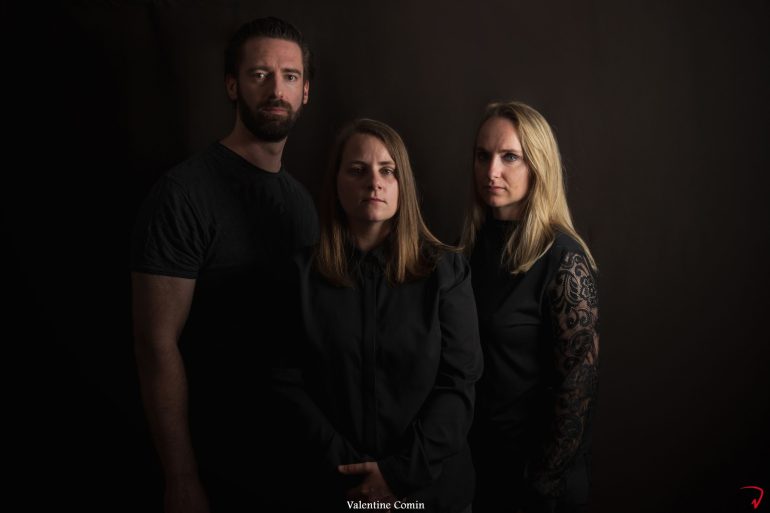
Working as a trio can be both challenging and liberating. How does your band dynamic affect the creative process?
Honestly, it’s the perfect combination. Being three is the ideal balance for us.
Vertigo has a strong atmospheric quality. How important is production and sound design in achieving that immersive experience?
Production and sound design are extremely important to us. We can be a pain in the ass sometimes (sorry to our sound engineer ahah!), but we know exactly what we want and try to guide the technical team toward our vision. We’re very satisfied with our sound, both in the studio and live. We also spend a lot of time composing and arranging orchestral and electronic samples, which are an integral part of our music. These orchestral parts add depth and act almost like a fourth band member.
How do you translate the layered and expansive sound of Vertigo into a live performance setting?
We’ve found a live sound engineer who does an incredible job, huge thanks to Matthieu!
He truly understands our universe, which is the result of a lot of discussion and preparation. Using our own equipment is also essential to reproduce the depth of our sound on stage.
The album is described as taking listeners on a journey. Was there a deliberate narrative or conceptual arc behind Vertigo?
The album is an emotional journey. The goal is to take listeners through different emotional states, and each person is free to feel whatever they want while listening. That said, there is an evolving narrative: it begins with preparation for the journey (Prior — adrenaline, excitement), then the departure (Expansio — determination, progression), discovery (Terra Incognita), questioning (Novae), doubt (Interspiratio), fear or escape (In Fuga), resilience and struggle (Unda), and finally the vertigo that comes from experiencing all these emotions in a short time (Vertigo).
Looking forward, how do you see Astreyane evolving after Vertigo? Are there new directions or experiments you’re excited to explore?
We are currently composing our second album. So far, the atmosphere is darker, while staying faithful to our way of writing music. And it already sounds loud… ahah stay tuned !