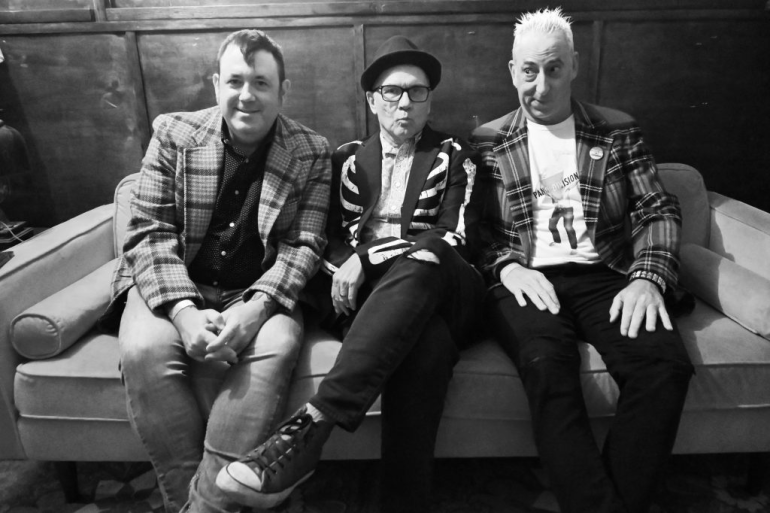
The Freak Accident: “We’d had some experiences as a group that made their way into those lyrics”
With The Midnight Show, The Freak Accident deliver what many are calling their catchiest and most experimental album yet. Blending heavy riffs, melodic punk, synth textures, and improvisational chaos, the record traverses dystopian sci-fi, religion, societal absurdities, and even dark humor. Spight reflects on the writing process, the evolution of the band, and how real-life experiences inform the music.
By Sandra Pinto
In this interview, Ralph Spight shares insights into the band’s approach to songwriting, the delicate balance between satire and serious themes, and the live energy that drives the recordings. From revisiting decades-old songs like Gill Transplant to pushing the boundaries of punk with drum solos and synth layers, The Midnight Show represents a bold, eclectic chapter in The Freak Accident’s ongoing evolution.
The Midnight Show has been described as your catchiest album yet. How did the writing process differ from your previous releases?
I don’t know if it’s the catchiest, I guess we’ll see. But I sent an almost finished copy of the final mixes to Jello Biafra and when I saw him he said something along the lines of “When I first listened to it I thought it’s your most commercial record yet, but as I kept listening I realized it’s your least commercial record yet!” I don’t know what any of that really means but I think it sort of sums up the dilemma of this record.
I’ve always felt that people make up their mind about you and your band after the first or second record and that never really changes. People seem to constantly be comparing this band to Victims Family, which is natural I guess, or expecting that this band will be like the first TFA record that Alternative Tentacles put out in 2004. That record was really a Ralph solo album where I played most instruments, had a lot of guest drummers, did more of a singer-songwriter thing and had a number of what you could really describe as pop songs.
Since then, there’s been three more LP’s and 2- EP’s which have definitely grown more on the punk/rock/surf/psych as time has gone on, but we haven’t had much in the way of any press or distribution, we’ve just sort of existed in this internet/bandcamp bubble playing mostly regional shows.
I think what’s interesting about this record is, while this line-up recorded “Outer Space Is Boring” and definitely put its stamp on it, those songs had been started with the previous line-up that recorded “Misfortune Teller” and the rhythm section had changed completely by the time the record was finally recorded. For “The Midnight Show”,though I wrote most of the songs, we arranged the songs as they came together, played them live a lot, and really got to know most of them pretty well before recording. A couple of the songs weren’t quite finished when we went into the studio though.
Most notably,we had only learned “Gill Transplant” about three weeks before the studio dates.
A lot of the other songs needed some finalizing of the lyrics but the band sounded so good I just felt we just had to record right away.
And then, of course it took me like another half a year to finish lyrics and overdubs.
The album blends heavy riffs, melodic punk, synths, and improvisational chaos. How do you balance such diverse elements while keeping a cohesive sound?
So we were were getting to the end of 2024, it was getting to be September or October and the band was sounding really great and I knew everyone was going to be traveling in December so I was worried we’d lose all of our steam if we didn’t capture what we had but also was worried we didn’t have enough songs.
And then I remembered “Gill Transplant” which was a song I had written for Saturn’s Flea Collar but then the band had broken up and I just put the song in a drawer and forgot about it. For almost thirty years.
So I taught it to those guys probably about a month before we recorded. And we had the arrangement but mostly they were just kind of signposts. We’d done sort of the same thing with “Make It Stop” from “Outer Space Is Boring” but the end of this song seemed much more fuzzy. We were used to improv-ing a bit, we’d jam in the practice space and sometimes extend things or have Brad make drum noise between songs when we play live since I used several alternate tunings on “Outer Space…” which necessitated a lot of guitar changes between songs.
So we cut the song with an arrangement that wasn’t completely solid and the final track is the second take. Everything is the band playing live except that Brad and I did a repair to the top of the third verse. Other than that one repair, all of the bed takes on the album are live.
The live guitars are through two amps, but I limited myself to one mono guitar overdub per track, I didn’t stack layers of guitars. I didn’t really think that the songs needed that and I thought the live recordings were so cool. In “Gill Transplant” it’s where the slide guitar comes in right before the sax solo. There are some noise tracks on that song, some sound effects records, tape samples, and this weird noisemaker synth I have. The same goes for “I’ll be your Toilet”. Austin wrote the body of the song up until the drum freak out and I wrote lyrics. I suggested we just noise out in G while Brad went apeshit on the drums, then I did a little solo toward the end, but none of that was structured. Again, only one mono guitar overdub allowed, but more noise stuff. We did end up editing “toilet” down to make it fit on the LP and I think that was a smart move. So I think minimizing overdubs really kept it feeling live, those two songs were the only ones where we really threw in the whole kitchen sink. The synths in “Fairytales” are really just me playing harmonics on my baritone guitar through an Electro Harmonix Micro Synth pedal.
Many tracks tackle dystopian sci-fi, religion, and societal absurdities. Which current events or cultural moments influenced the lyrics most?
I can’t really isolate anything in particular because we’re just being bombarded with endless misinformation, disinformation, lies,etc. It seems like the whole society gets turned upside down everyday. The effect is to overwhelm people so they feel powerless. The whole psychic and media environment is a bad dystopian sci-fi midnight show. So that’s the connection.
The debut single Don’t Blame Me is said to mark the point where the band truly became a unit. Can you expand on what that moment meant for The Freak Accident?
For me, “Don’t Blame Me” was one of those songs that came about really naturally and easily. The inspiration was a booking email conversation that got me thinking about how when you’re playing local band shows everyone is trying to get the best spot on the bill, usually second of three, especially on a weeknight. There are some allusions to real events, opening bands playing too long, someone talking to me and my friends at a Taqueria that the opening band at a certain show (aka us) were soooo boring. We literally had the bar call last call in the middle of our third song at one gig. So the lyrics came together easily because we’d all lived it. There have been a lot of different line-ups of the freak accident and through all of those certain members have wanted to make it more of a band than a Ralph Spight solo project but I think this line-up really coalesced as a band because of all of the weird adversities that came along with playing a lot of weird little dive gigs.
The album contains tracks like Gill Transplant and I’ll Be Your Toilet that mix noise, pop, and experimental elements. How do you approach experimenting with song structures?
I kind of talked about it before, but really those two songs were less structured. I’m used to playing in bands where every last note is figured out, sanded down, put in its proper place and I love that. But it’s also interesting to have a structure that’s not so finished and play to the feel of it. We have cues and things we’re listening for but it makes it so we can also tweak the songs on the fly in a live setting.
Humor seems central to your music, even when tackling serious themes. How do you find the right balance between satire and message?
I’m not always sure I’ve always found the boundary. With this record to some degree on a few tunes, I basically just resigned myself to the fact that some of the lyrics are just nonsense, which felt sort of freeing. And others are stories,tracts or whatever. I think satire is really hard to do in a band and I’ve written some stuff with the best of intentions in the past and thought “that didn’t work so well” afterward. But I just keep going and try to do better next time.
Fairytales features synth layers and a drum solo, which is unusual for punk. Was this a conscious attempt to push genre boundaries?
My whole career I’ve been trying to push the boundaries of whatever I’m doing. While making this record I just think that Brad’s drumming is so unique and powerful and has so much personality that I just wanted to put it out front a lot more. The thing with “Fairytales” is that the drum beat is actually pretty restrained throughout the song which I think makes the drum solo pop out a lot more and makes it that much more jarring. That whole song came about on a whim a little bit. I was working on “Catbird Seat”, listening to a practice room recording of it and I just thought “there needs to be another song right behind this one that keeps this whole punk rock dance party vibe going” and so “Fairytales” came out of that.
The title track came from an inside joke about playing last at shows. How important are personal band experiences in shaping your albums conceptually?
Well, I think in this case it was. But we weren’t necessarily trying to create a concept or a concept album. We’d had some experiences as a group that made their way into those lyrics. And I always think that tapping into real experiences makes for more powerful lyrics so those types of songs tend to be easier to write.
With The Midnight Show framed as a concept album through a dystopian sci-fi filter, how did you plan the narrative arc across the songs?
Basically, after writing “Don’t Blame Me” I realized I’d never written a “Welcome To The Show” kind of song before, but of course it’s tongue in cheek because it’s about playing last while everyone’s leaving.
We were looking for a title for the record and I kind of latched onto “The Midnight Show” pretty early on though I don’t really think it’s all that catchy or memorable as a title. But it did sort of have this thread that seemed to run through the songs with this sci-fi,dystopian,late-show vibe so I think the title sort of defines the concept more than the other way around. I like writing from sort of a failed science fiction, B-Movie perspective and there’s more of that than usual on this record with “Gill Transplant” and “Busted Time Machine”. Other songs have a touch of that while remaining topical such as “Fairytales”. Some songs are just dark. “I’m Still Here” really is a song about having so many friends die recently but through this lens of playing tongue in cheek about being immortal. It’s about the downside of living forever. I realized after writing it that it just shows how my default setting of lyrical sarcasm is just totally inadequate for talking about grief and immortality. But again, it’s kind of nonsense. “Down In The Dumps” is about depression. It’s also an example of a thing I like to do which is to tweak ordinary blues structures using weird effects; “Mean Old World” is also an example of that and both of those songs really deal with depression and just the general hopelessness of modern existence. Again, I didn’t and I don’t set out to write concept albums but topically I’m usually touching on different aspects of the same ideas at the same time.
Eye-catching album art by ZOLTRON accompanies the release. How do visual elements factor into your creative process?
Our bassist Austin Lannan is an accomplished package and graphics designer who’s lent a strong visual style to our posters and albums. He designed the cover for “Misfortune Teller” before he was even in the band and also did “Outer Space Is Boring” once he joined the band. Having Austin around really gives us a secret graphic weapon that helps get people into the music.
I know Zoltron through Victims Family and Austin and I were both simultaneously thinking that he should do the cover for this record so I just hit him up and he was completely stoked to do it. Z has been super supportive and encouraging throughout the process and has been really highly complimentary of the record.
The album is released through both Nerve Center Recordings and Nadine Records. How have these labels supported your artistic vision?
Nerve Center is my little imprint that I’ve been releasing the Freak Accident records through since the second record in 2007. I’ve only recently been doing more with selling into mailorder shops and getting some record distribution. But it just came about as a necessity after Alternative Tentacles didn’t pick up the second record.
Again, Nadine Records was a connection that came through Victims Family; we had played a number of shows with Nadine Records head honcho Mandy’s band Nasalrod since 2019 and released the Victims Family/Nasalrod split LP “In the Modern Meatspace” in 2024. Mandy’s been just a total pleasure to work with and really works incredibly hard to promote her artists.
I’d planned to just release the Midnight Show on Nerve Center but Mandy saw the Freak Accident play in Portland last August and I sent her a Soundcloud link of the final mixes and she wrote me back a few days later saying how much she loved the record and wanted to put it out. So we decided to do a split release.
I’m really grateful for the team we’ve put together for this record, the band, the labels, Zoltron and our publicist, it just feels like everyone’s really excited to be a part of it.
You have upcoming US tour dates alongside the album release. How are you planning to translate the eclectic, experimental nature of this record to a live setting?
As I said before, the band really is a live entity, there’s not that much that is much different from the album. I like to make records that sound like records and don’t usually worry too much about making sure they translate 100% live. But on this record, there’s some overdubs but not that much…so the liveness of the album is pretty much what you get live. I don’t think anyone who sees us after hearing the record will be disappointed.
Looking back at your career, how has The Freak Accident’s sound evolved, and what does The Midnight Show represent in that evolution?
I’ve always just written what comes out naturally in this band. I think the band’s sound has evolved most when it changed from me doing all the tracks and then having musicians play live and going through the various line up changes. At that point it went from a singer-songwriter thing to more of a band. All of the line ups have put their own stamp on the sound and even though the material crosses genres, I think there are things we keep coming back to. Punk Rock, Heavy stuff, some odd times, garage punk, surf and improvising run throughout the entire catalog. It might not be a cohesive sound but we work a lot of the same styles again. I just think that this line up has simply played a lot more than the others and so we’ve been able to expand the palette a little bit more on this record and the playing is a lot more, I don’t know how to say it, desparate or something.
Foto: Amber Carson-Miller