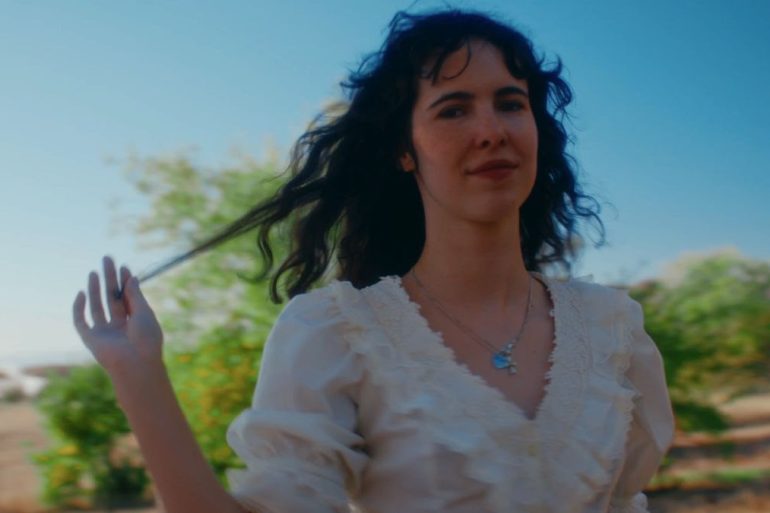
Haylie Davis: “There were some magic moments in the studio while recording this album where the stars were aligned”
Emerging artist Haylie Davis takes listeners on an intimate journey with her upcoming debut album, blending folk, pop, rock ’n’ roll, and country into a distinctive, heartfelt sound. In this candid conversation, she opens up about the unpredictable nature of her songwriting, the moments of studio magic that bring songs to life, and the personal connections that have shaped her musical path. From reflecting on influential artists like Joni Mitchell and Gram Parsons to navigating the challenges of the music scene, Davis shares the inspirations, collaborations, and philosophies that define her work.
By Sandra Pinto
With a focus on authenticity, self-discovery, and creative perseverance, this interview reveals the story behind songs like Country Boy and offers a glimpse into the evolving vision of an artist committed to making music that resonates deeply with listeners.
Haylie, your new single “Country Boy” carries a strong emotional weight and a “cosmic Americana” feel. What inspired this song and the story of this lost country boy in the big city?
This might sound funny, but I didn’t sit down and consciously think about writing this song. My writing process usually consists of picking up the guitar or sitting at the piano and hoping a good song comes. I don’t usually feel in control over what the subject is or even how it sounds. Sometimes when I write, I don’t know what the song is about until later. “Country Boy” was a song that felt random at first, but as time goes on, it has resonated with me more and more. I first wrote the chorus in 2022, and the rest of the song didn’t fall into place till about a couple years later.
You’ve described the track as a tribute to boys from the Midwest and the South who leave everything behind to move to Los Angeles. Is there a personal story or experience that drew you to this theme?
A lot of the people I have encountered in the music scene are transplants from elsewhere. The majority of these people happen to be men because music is a male dominated industry. The personal dynamics with the people in the scene can feel complexly interwoven, and I think “Country Boy” was my attempt at describing these feelings about them. However, I’d like the listener to find their own meaning in the song.
Musically, “Country Boy” echoes elements of Linda Ronstadt and classic melancholic ballads. Which artists directly influenced the sound of this track?
This track was less so a direct inspiration of something else. Musically, my inspirations at the time were Joni Mitchell, Linda Ronstadt, and Gram Parsons, to name a few.
The song was recorded live in a single take. What made you choose such a raw and vulnerable approach? And what was it like to capture everything in one moment?
To be honest I don’t think it was one take, but it was definitely a live take. There were some magic moments in the studio while recording this album where the stars were aligned, the band was on, the tape was rolling, and I got a vocal I liked all at the same time. “Country Boy” was one of those songs. We didn’t have to go back or edit anything, and at the end of the performance, we all knew we captured the song. It feels like you just caught a butterfly in a jar or something. It’s hard to get a song all in one piece like we did. A lot of times in the studio, you’re searching and searching for the song, doing take after take. Maybe someone’s guitar is out of tune or you crack your voice on the last verse, and you have to do some audio surgery to get the song to where you want it to be. Not “Country Boy.” It was clean as a whistle.
The official video, directed by Gabriella Kashi, has a cinematic and intimate feel. What was the creative process behind the visual interpretation of the song?
Gabriella Kashi has been a hero of the music video world for me. She has been able to capture the visuals of both my singles very effectively. Kashi did a great job directing and her talented team worked hard to make it come to life. Im very grateful for their help.
Your previous single, “Golden Age”, also carried a luminous melancholy in its songwriting. Do you see “Country Boy” as a continuation of that narrative or the beginning of a new chapter?
I think both of these songs share a similar sonic landscape for sure. The songwriting and production style has a similar tone to them; this was coincidental, and largely due to the fact that these two songs were recorded in the same studio. As for the narrative, they are very different. I’d say “Golden Age” has more of a zoomed out perspective on society and “Country Boy” is a little more zoomed into a specific time and place.
You’re preparing your debut album for 2026. What can you reveal about the musical direction of the record? Will it continue blending folk, pop, rock, and Americana?
I’d say the music direction of this new record is a combo of folk, pop, rock n roll, and country. Compared to my last project, Lady Apple Tree, these arrangements are more full band and the songwriting a little more complex.
Critics have said your voice lives somewhere between Judy Collins, Carole King, and Emmylou Harris, but with a post-Gen Z sensibility. How do you feel about those comparisons?
I don’t listen to Judy Collins much, although I think she has a great voice. Emmylou and Carole King are great! I love Joni Mitchell, Bob Dylan, and Gram Parsons too. Recently I’ve been listening to John Coltrane, Bjork, Stevie Nicks, and Shania Twain. I go through many different music phases and I listen to a wide variety depending on my mood. I don’t mind comparisons, but I’m never interested in replicating something that’s already been done. I just listen, observe the world, and make what feels true to myself. Like I said before, I don’t feel as in control of the songs I write as much as you might think.
You’ve contributed vocals to projects by Sam Burton, Drugdealer, Sylvie, and Alex Amen. How have these collaborations influenced your identity as a solo artist?
I think what all of these people and I have most in common is that we share a deep love for similar music. Or at least, we’re circling around a similar wellspring of inspiration but we all approach music in our own unique way. These people are all closely woven into my story of becoming the artist I am now. One of my sound engineers, Ian Doerr, and who recorded a lot of my new album, was at a gig of mine at a dive bar near Koreatown back in 2019 when I was in a folk duet act called Will and Haylie, featuring Will Worden. Doerr recommended me to Drugdealer, so I went and sang on a few of their songs and that is how I met Sam Burton. Sam is a huge part of my music career as a collaborator, player, and confidant. He’s my biggest supporter in a lot of ways and played a huge role in the production of this upcoming record. He recommended me to sing in Sylvie, and that’s how I met my current band. I introduced Alex Amen to Sam Burton and our band when I was on a Sam Burton tour in 2023. I originally met Amen in 2018 where we attended the same college. I also ended up meeting Will through Alex during this period. Alex and I both ended up dropping out and he encouraged me to pursue music. I moved to LA and he moved to Vashon, Washington but we stayed connected. We reconnected in 2022 when he saw the Sylvie show we played in Seattle, and he decided to move to LA. This is a very long story short to say that we’ve all kind of propelled each other to where we are now.
The lyrics of “Country Boy” touch on regret, displacement, and difficult choices. When you write, what comes first for you: the narrative, the emotion, or the melody?
It usually comes out all together. I’ll sit down to write and just strum and hope for the best. I’ll sing over some chords and sometimes the words just come right out. Sometimes it’s gibberish and I have to decipher what the words might be. Sometimes I’ll have a melody or words come into my head and I work out a song right then and there. You never know when inspiration will strike. If I’m ever thinking too hard, it means I probably am not writing a song I’ll keep. This is only my personal process and it works differently for everyone. I have this notion that ideas are floating by like balloons in the sky and when one flies over your head that you like, you can try and grab the string to pull it down. Sometimes you let them pass by, and other times it’s flying too high and you can’t reach the string even when you try. Sometimes you grab the string and bring it to land and now it’s yours, and other times you bring it down only to decide to let it go again- maybe onto the next artist who’s waiting for an idea. Who knows! I try to keep myself as available as possible, and keep my work disciplined. You have to be digging to hit gold!
Los Angeles has become home to a new wave of young troubadours, something many compare to a “new golden era.” How would you describe your place within that scene?
Even though I feel like I am a part of something, I am doing things my own way. I’ve made friends here and I’ve made enemies; I’ve gotten lucky and I’ve struck out. It’s important to remember who you are so you don’t get carried away in the era of algorithms and followers. It can feel competitive at times and it will only hinder your process to compare! I’ve been in this scene a long time now- I have learned so much, and there are some wonderful artists making beautiful music. I do my best to trust my unique path and where it leads, and to whom it leads.
After “Golden Age” and “Country Boy,” what do you hope listeners understand about who Haylie Davis is as an artist before your album arrives?
I’m not quite sure! This has surely been a journey to remember. It hasn’t always been easy- I’ve had to work from the ground up and there’s still a long way to go. To the growing artists out there, the hardest part is jumping off the cliff and committing to your work, but I encourage you to do it. It’s worth noting, though, that when you jump, you can’t go back and your life will change forever. I worked for a long time as a waitress living paycheck to paycheck and even though it was hard, I wouldn’t have it any other way. I’ve been tested in all directions, but the world is teaching me to believe in the impossible. I’m beginning to trust even though I am resistant. I’m so grateful for the people who have supported me so far, or else this album would not be possible. It’s rare to have people believe in you, and even rarer to believe in yourself. I want people out there to know that even though times are tough right now, you can still dream of something better! I believe change comes from the desire to change. My wish for my music is for it to create the opportunity to connect. My next single will be out in January!
Thanks so much!