


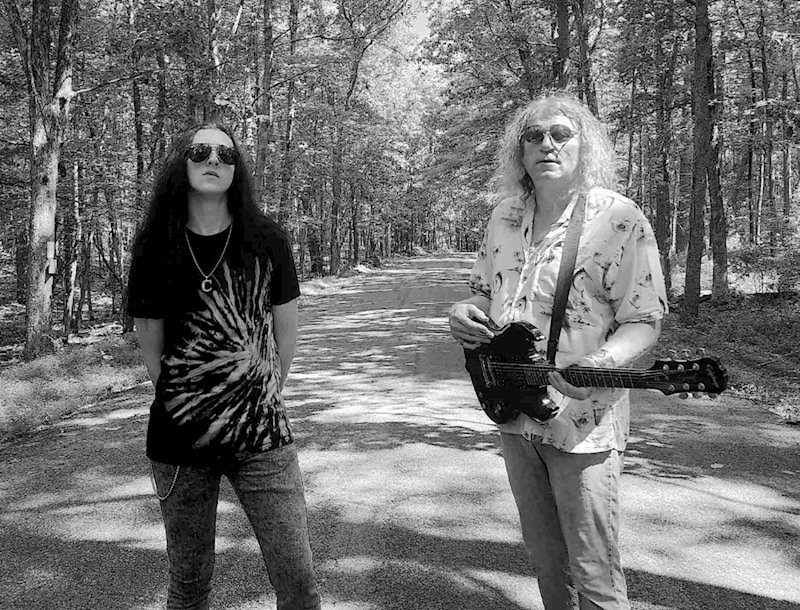
With more than three decades in music, Robin Ross continues to explore different creative territories, blending classic rock, progressive rock and other influences that run throughout his various projects. Alongside Carmine Gontz, he now brings “Blood Lines” to life, a song that explores memory, family heritage and the connections that endure over time. Inspired by a poem written by Robin Ross, the track brings together two generations and distinct musical sensibilities, reflecting the creative freedom of both artists.
By Sandra Pinto
In this interview with LOOK mag, the two musicians discuss the origins of the song, Robin’s return to music production, the work at Baa Baa Leaf Music studio and the paths they hope to explore in the next chapters of their careers.
Robin, you have been making music, writing songs and producing for more than three four decades. When you look back at where you started in the New Jersey and New York scenes in 1988, what still feels connected to the musician you are today?
Robin Ross – I guess the chords. A D chord is still a D chord and so on. So, the root of it is Music. Original music is an expression, with a message. I am never short of either.
You have worked across different projects, bands and recording environments over the years. What has kept you creatively restless after all this time?
Robin Ross – My spirit and old soul. I have creative thoughts from the time I wake up till I rest, and often my dreams. It is not limited to just music. I have written novels, screenwriting and poems. There is no off switch.
“Blood Lines” is built around the idea that some connections survive across generations. Where did the song begin for you — with the music, the story or the idea of the bloodline itself?
Robin Ross – The lyrics come from a poem of mine of the same name. I have a deep ancestry among Norwegian fighters and kings. When the right situation envelopes me, I can transcend through older generations and see it clearly and visually. These visions must not remain silent and therefore we have this poem and this song.
You describe bloodlines through images of birth, death, grandparents and the passing of time. How personal is this song, and how much of it comes from observing your own family and life?
Robin Ross – Time is really all we have while we are here on Earth. Yet it changes as you get older. When you’re young on this planet, time is no concern until friends and family pass on. With each passing, we begin to accept our own mortality. As we age, time becomes more precious and we wish not to waste it like when we were young.
There is something almost circular about the song: a baby is born while a grandparent moves “up in the sky”, and life continues. Were you trying to capture that cycle of life rather than simply writing a song about loss?
Robin Ross – I was trying to catch the entire evolution of a family and their generations. How it battled to survive through centuries or more. And how the wisdom was and is passed down each generation.
Carmine, what immediately connected you to “Blood Lines” when Robin brought the song to you?
Carmine Gontz – When I first heard the song, I was immediately connected to the history of the song. Obviously I was very honored for Robin to have thought of me to sing the song, but after hearing it I felt a connection to the lyrics, the melody’s and the vibes of the song. I was happy to help Robin bring Bloodlines to life in 2026!
Your voice and artistic identity bring a more theatrical and cinematic dimension to the track. How did you approach interpreting a song that deals with such intimate themes?
Carmine Gontz – I definitely wanted to put a lot of emotion into my singing on this track in particular. With a song like Bloodlines with such a story, it was important to really put a lot of passion into this one. Even in the video I tried to give a performance fit for the mood of the song with my own look and style. I tend to belt it out a lot on this song but tried to find a happy medium where my vocal performance fit with
the music and atmosphere of the song.
Robin, you reunited with Frank Cinquegrana, Scott Cowan and Joe Torres to work on new material after years away from music while pursuing a career as an energy engineer. What made 2021 the right moment to return?
Robin Ross – 2021 was a time for new horizons. We often get them every 7 years. And, I had been away from music production for 20 years or more. However, I never stopped playing the guitar or piano. In these years I recorded a lot of new material and documented it by recording it on my phone. There became this backlog of songs. I decided it was time to put these songs into production yet I didn’t know the new ways of recording music. I come from the analog tape days. In 2021, Bill and Joe bass visited one weekend and we developed 10 songs together in two days and recorded it all on Pro Tools. That was the spark that lit the fire in me to progress towards a full production studio. I knew it was the first time I saw Bill in over twenty years. I didn’t know it would also be the last time I saw him. We had a bunch of phone calls after that until he passed away in Oct. of 2021. This motivated me even more and perhaps is a big part of the fuel that fires my creative soul. This also motivated the rest of the band and we wrote and recorded songs before you knew it.
How did returning to music and building Baa Baa Leaf Music change the way you approached songwriting and recording?
Robin Ross – A recording studio has a life of its own. Unless it has an upfront budget, it builds over time – much like we age. There are minor upgrades and then there are major changes. It's like a child in a way. My early studios were built so we could practice while recording songs. This not only helped preserve and develop the song, it became a standard way to have a rehearsal with headphones and a controlled
environment. So when it came time to record the song, it was the same as rehearsal but with a finished song. I have once again achieved this method and in addition this time I have built a live room where you can rehearse as a full band but you are multitracking at the same time – without headphones.
“Blood Lines” was recorded at Baa Baa Leaf Music, where you also produced and mixed the track. How important is having your own creative space to the sound and identity of your music?
Robin Ross – At this point I wouldn't know how to create without it. The studio really is another instrument. As a writer I can do an entire song on my own as a demo and then bring in musicians and either re-record it with them or replace my tracks (like the drums).
Jonathan Duckett handled the mastering, bringing experience from working with artists such as Philip Glass, Kenny G and David Sanborn. What did you want him to bring to the final version of “Blood Lines”?
Robin Ross – During production, having another quality ear is vital to check on his speakers or listen at the studio. Jonathan is very keen on Pro Tools and its capacity and his ear is also very good. He went through the song with a fine tooth comb and collaborated with me as to the direction we should aim.
The song has a strong classic-rock foundation, but the guitars and harmonies give it a more expansive, contemporary feeling. What were your main musical references when shaping the arrangement?
Robin Ross – Pink Floyd comes to my head with a metal edge. If you were to remove the vocals, it would sound more like Pink Floyd but the vocals add that other flavor to change the arrangement.
Carmine, your own music combines gothic atmosphere, classic hard rock and theatrical elements. How much of that identity do you see reflected in “Blood Lines”?
Carmine Gontz – I saw a lot of things in Bloodlines at first listen that inspired me. When I first heard the song, I was thinking of a vocal reminiscent of Bruce Dickinson from Iron Maiden. I tried to give the song my own vocal spin, and I think the song couldn’t of came out better.
You have already worked with musicians and producers connected to artists such as Ghost, Motionless in White, Ace Frehley, Mr. Big, Quiet Riot and Ozzy Osbourne. How have those experiences shaped the artist you are becoming?
Carmine Gontz – These experiences have shaped the artist I am in a huge way. I learned a lot about the production process first working with Dan Malsch. After working with Matt Starr and having Rudy Sarzo and Mike Dupke play on my song “Lost In Space” I feel I grew a lot as a musician and writer. I learned a lot about how to market myself through working with Dan and Matt as well as tracking instruments and vocals in the studio. Growing up Metal Health by Quiet Riot was one of the first CDs I ever got in my life and had a huge impact on me so I never would have imagined working with Rudy Sarzo years ago. It’s definitely instilled a bigger confidence in me working with artists like Rudy and the other amazing musicians
Robin, Jack’s Maze emerged in the early 1990s with a progressive-rock sound influenced by bands such as Pink Floyd and Led Zeppelin. How much of that musical DNA remains present in what you are creating today?
Robin Ross – I would say all of it. “Blood Lines” is ultimately about love, memory and what we inherit from the people who came before us.
What do you think we inherit that has nothing to do with genetics?
Robin Ross – Wisdom, Power, Wealth, Tradition.
The song is being released as part of the build-up to Once in a Blue Moon. What can listeners expect from the album, and how does “Blood Lines” fit into its wider musical world?
Robin Ross – The years of absence have added a sense of where to go and what to let go. Blood Lines is crafted after another song of mine called The Tall Grass off the album “Kingdoms Freedom”. The tempo has changed and all the parts have also changed but the roots remain. Jacks Maze changed that into what Blood Lines is now. The instruments are all changed and it's a well thought out format. And Vocals were added.
Robin, you have also been exploring different sides of your sound through The Melodynes and The TW Howlers. What keeps you moving between different musical identities rather than staying inside one particular style?
Robin Ross – I just can’t be confined into one genre. I enjoy the writing process with others too. I like to expand my horizons and the different genres are wonderful to explore.
Carmine, you are currently working on your debut album. At this stage of your career, what are you most determined to establish about your own voice as an artist?
Carmine Gontz – I’m in the process of finishing my first EP. It’s a few songs that I have been in the making of for a couple years and a couple new ones. These songs represent me very well as an artist, where I am and where I started. I can’t wait to finish these tracks and show people the unique sound inspired by many different genres I love on this EP. I mainly want people to feel a connection to my voice, the lyrics, my style, my authenticity. I just want to play the music I love and write the words I feel or want to say hoping that people feel a connection to it.
Both of you come from very different points in your musical journeys, yet “Blood Lines” brings those experiences together. What did each of you discover about the other’s approach while working on the song?
Robin Ross – Carmine is easy to work with. He is quite mature for his age. I am an old soul and he shares that with me. He listens well and projects his contributions with a pleasant style. His ideas are great and I look forward to working on more songs. He has his own thing too so working together is not a tight schedule. I think the song was a good introduction for him and us together. When I was his age, I liked heavier music like Black Sabbath, Iron Maiden, in addition to Zeppelin, Rush, Floyd etc. When we get older we don’t lose those influences, we tend to just mellow out. Working with him allows me to express that side of me.
Carmine Gontz – Robin is very dedicated to the studio. He had most of the song ready before having me track my vocals and he still put so many hours of work into this song after we worked together. It’s very inspiring how much work he put into Blood Lines and I’m very happy to have been a part of this incredible project!
Robin, after more than 30 years of music, studios, bands and different creative projects, what still surprises you about the process of making a song?
Robin Ross – How quickly a song can go from zero to completion. I like writing songs out and developing them through time too. However, my biggest Melodyne song off of the “Come on In” album, All I Want, was written in one or two passes on the 12 string. I also wrote the melody on the second go through and sang words off the top of my head. I peeled the chords and words off the phone. I changed a lot of words with help from JoEllen. It was recorded and dropped on a multi-track and it was done. Sometimes this magic happens and it's always a surprise. And it is still a surprise how that song and process continue to flourish.
And finally, if “Blood Lines” is about what remains after people are gone, what would you like listeners to carry with them after the song ends?
Robin Ross – We are part of a bigger world than we know. Generations of wisdom are carried on to help future souls. Love forges forward and when our bodies have expired here on earth, our souls will soar into the blood lines of generations.

