


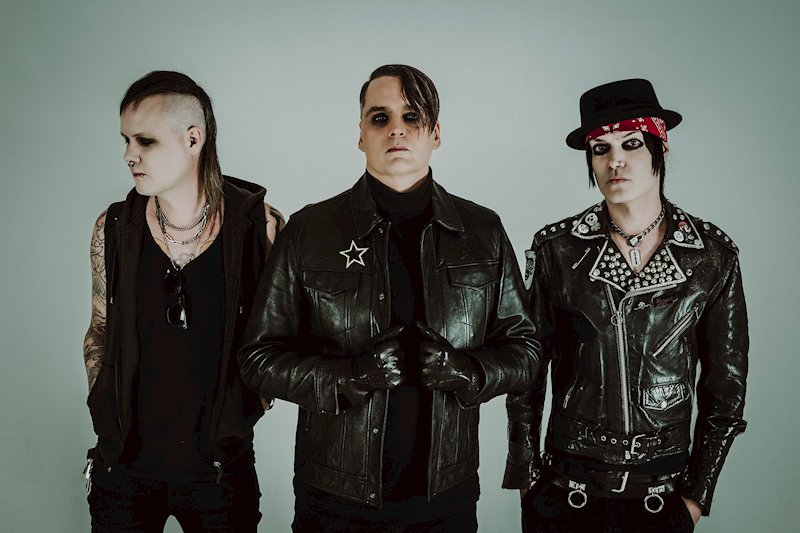
Since emerging from Stockholm in 2012, Then Comes Silence have carved out a distinctive place in the dark post-punk and gothic rock landscape, constantly evolving while remaining true to their restless creative spirit. Now approaching their eighth studio album, Requiem Ballroom, the Swedish band embrace contrasts, experimentation and a world increasingly divided into opposing sides. Conceived as a two-part record, Requiem Ballroom separates “Ballroom” and “Requiem” into two distinct sonic and emotional experiences, each shaped by a different producer. From the post-punk intensity and unmistakable influence of Killing Joke on “Judgement Day” to unexpected electronic elements, the album finds the band exploring new territories without losing the darkness and energy that define their sound.
By Sandra Pinto
In this interview with LOOK mag, Alex, Hugo and Jonas discuss the creative vision behind Requiem Ballroom, the influence of their musical heroes, the band’s evolution into a three-piece, and the importance of keeping curiosity alive. They also talk about the Stockholm goth community, the joy behind the “Judgement Day” video and what it means to keep moving forward after more than a decade in the underground scene.
Alex, you’ve described “Judgement Day” as the first song you wrote for “Requiem Ballroom” and an homage to Killing Joke, while Hugo, you’ve mentioned Geordie Walker’s influence on your guitar sound. What is it about Killing Joke’s sound and attitude that you wanted to bring into this particular song?
Alex: They have been a large influence to me since a young age. I still remember the day I bought their first album on vinyl in a second hand record store next to the school where I was going. I was immediately hooked. That said, the goal with the song was never to make an homage. As we were working on it, we gradually started leaning more and more towards a sound that reminded us a lot of them, and we didn’t mind that at all. Hugo did a great job with the guitar layers and harmonies, so we thought it would be fun to just go with it.
That being said, I don’t think the chorus sounds anything like them, though.
Hugo: Yes, it’s more like a little tribute to Geordie rather than a homage to Killing Joke as a whole. Recently I’ve been a bit obsessed with Geordie’s sound and style, and I thought that it would suit the song well. Anyway, we’re all really sad that we’re not going to get any new Killing Joke music or see them live again.
“Judgement Day” embraces failure, bad decisions and reckless behaviour, yet there’s a strange sense of joy and self-irony running through it. How much of the song reflects a genuine “live without regrets” attitude, and how much is your way of laughing at yourselves and getting older in rock ’n’ roll?
Alex: There’s joy in not being regretful. You can go far with a laugh and a smile.
The song also introduces a techno/electronic element into what is otherwise rooted in gothic and post-punk traditions. What made you want to bring that unexpected influence into the track?
Alex: The euro techno melody that’s basically on a loop through the whole song came up by coincidence. It was a little bit of a joke. I was fooling around while playing with my synthesizers and suddenly there it was. I’m usually not so fond of that vibe, but in this case I couldn’t let go of the synth melody. It became a symbol for something we normally wouldn’t do. A failure or a misstep. We had to keep it. It’s a hook. To be honest, I had a difficult time listening to it over and over again during the recording and rehearsal sessions. I like it now and I
can’t imagine how it would be without it. It’s the rail track of the song.
The video turns “Judgement Day” into a final party, with you essentially performing the song like a live concert while the extras dance around you. What did you want the visual story—and that spontaneous atmosphere—to add to the song?
Jonas: This time around, we went for a classic take on the music videos: the band playing and people having a good time. Sometimes, it doesn’t need to be more complicated than that. The difference between the singles is the colour scheme: white, black, and red. It’s always fun and interesting to have your friends participate. We recorded the videos in different locations, but mostly with the same people, and we tried to make it feel like a nice pre-party, offering drinks and so on. And we definitely had a good time.
Alex: We didn’t make a video with a story or a script. We focused on the good vibe and having people around dancing while we were playing our song. It has become one of my favorites.
You’ve also released a behind-the-scenes documentary showing the making of the video and the Stockholm goth community. It reveals a very warm and playful side of the band and the people around you. Why was it important to show that side, and do you think there’s a misconception that goth and post-punk communities are exclusively dark or serious?
Jonas: It wasn’t our idea to make a behind-the-scenes–documentary. One of the participants in the music video has a YouTube channel (MarzipanMoonlight) where she covers all goth things, like makeup, reviews and whatnot. Check out her channel, it’s great!
And, of course, Hugo the miniature pinscher became one of the unexpected stars of the shoot. How did a nearly deaf 16-year-old dog end up becoming part of the story?
Jonas: Our dear friend Adina (Klubb Död) was one of the participants in the music video, and Hugo was always with her wherever she went. Actually, Adina and I were a couple many years ago and we had three dogs together. Hugo was the last one still alive. Unfortunately Hugo passed away recently, but I’m glad that he couldjoin us for the music video, a last goodbye. He and his two brothers will be forever missed. I feel very privileged to have had them in my life.
“Requiem Ballroom” is divided into “Ballroom” and “Requiem,” with Jon Bordon and Tom van Heesch mixing the two halves respectively. What are the conceptual and emotional differences between the two sides, and how are those differences reflected in the sound?
Alex: I had a strong vision about the album in an early stage. I introduced the concept to the band and we agreed to split the two halves into two different productions. The two sided album is an experiment. I want to keep them separated and make people choose which one they like more. The basics of the concept is right in front of our eyes everyday and everywhere. We have created a very polarized world in the last couple of decades. Everything is black or white, red or blue, right or wrong.
There’s not much going on in between, in the middle. So… let’s play a game with the two sided concept. I had separate meetings and briefings with the two mixing producers, Tom and Jon, giving them different directions and guidelines. They were both the perfect pick for each project.
This is your eighth full-length album. Looking back to the beginning of Then Comes Silence in 2012, what do you think has changed the most in the band’s sound, songwriting and identity?
Jonas: TCS was very guitar-based in the beginning, with a wall of sound. The guitarists were fighting to be the loudest, in a deliberate way. Over the years, we have evolved into a more dynamic sound, with more space for electronic elements. Neither is better than the other; we like both. It’s just natural for a band to evolve and try different things. It would be meaningless to be stuck with a signature sound and not progress. Writing music is an ever-evolving experiment, and curiosity is one of the most important ingredients.
Since becoming a tightly focused trio in 2022, has the three-piece format changed the way you write and perform—perhaps making the band more direct, aggressive or uncompromising?
Hugo: The writing process hasn’t changed at all: Alex writes the songs and then we arrange them together in the rehearsal studio.
The way we perform has changed, obviously. There were a lot of synths in the studio recordings that were missing when we performed live. We tried to recreate that between the two guitars, which sometimes worked well, but other times felt a bit too noisy and messy in my opinion. When we realized that we had to go on our first US tour with only one guitar, we decided to fill the gap by adding the synths and keys from the recordings as backing tracks. It worked so well that we decided to continue this way. A few people still complain about missing a second guitar in the recordings, which I find quite funny. They don’t realize that we can record as many guitar tracks as we want in the studio, and we record tons of them. So if a song has fewer guitars, it’s just a premeditated artistic decision.
You’ve toured extensively across Europe, North America and Latin America, with Germany becoming something of a second home. What is it about the German post-punk and goth scene that has created such a strong connection with Then Comes Silence?
Hugo: Germany has the biggest post-punk and goth scene in Europe, with the biggest festivals in the genre, so it’s kind of natural that we play there quite often. And it’s “quite close” to Sweden, if you can consider a whole day of driving and two ferries close.
You’ve shared stages with influential bands such as The Chameleons, The Fields of the Nephilim, Clan of Xymox and A Place To Bury Strangers. Is there a particular artist, tour or show that changed the way you think about performing live?
Alex: Maybe not so much about changing the way of performing, but more as a guidance of how you should be doing, or not be doing on and off stage. Some bands take everything for granted and go completely on autopilot. No passion, just press play on tape and that kills the spirit. The audience deserves better than that. Other bands like A Place To Bury Strangers showed me how to be professional and respectful.
I had the pleasure of touring a lot with them in my former band previous to Then Comes Silence in the late 2000’s and early 2010’s. We opened for them in the UK and Europe. They gave everything on stage. We shared the backline and instruments sometimes. No diva-like behavior. They even helped carry our gear and load in and out from the venues. That’s how you share the love of music.
You’re about to perform “Judgement Day” live for the first time at M’era Luna. What are you expecting from that first performance, and does
introducing a new song to a festival audience feel different from playing it for the first time in a club?
Hugo: I wish I could go back in time to August before M’era Luna, but unfortunately I can’t. Playing a song live for the first time is always difficult for me. I need to think, which I don’t have to do with songs that I’ve played hundreds of times and I just “go with the flow”.
I think it’s different indeed playing a song for the first time to a festival audience, from playing it at a club. A bit tougher. Set times are short and people just want to have fun, which they usually do with songs they know well and can sing along to. But anyway, it went really well. It’s an easy-to-enjoy song. I realized that when we shot the music video, people who had never listened to the song before were dancing like crazy.
If “Requiem Ballroom” is your soundtrack for the end of the world, what would you want people to be doing when the final song plays?
Hugo: I would want them to think about whatever they have left on their bucket list, that they can actually get done in four minutes and thirty-one seconds, because that’s all the time they would have left in this world.

