


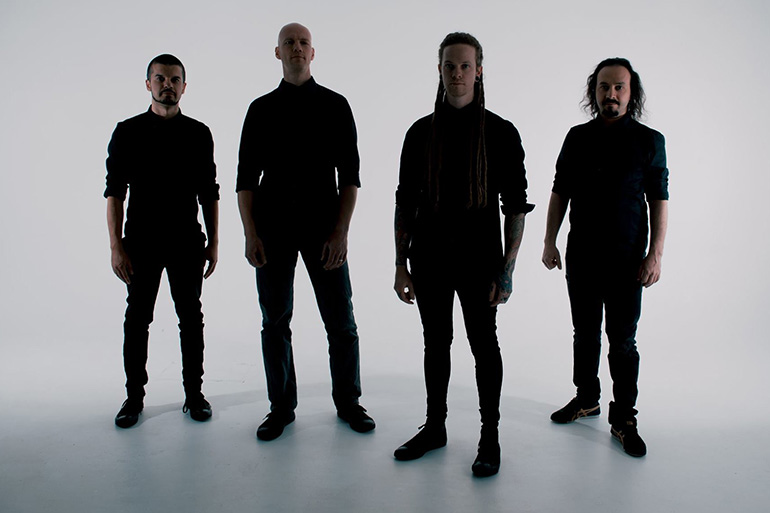
“Cult of the Sun” is a concept album inspired by the life of Akhenaten, the Egyptian pharaoh who sought to reform the religion and society of his time. In this interview, we explore with Black Sea of Trees the connection between history and music, the narrative construction of the album, and how cultural and philosophical elements are translated into dense and emotional sounds. We discuss the protagonist’s journey, the balance between euphoria and destruction, and the composition process that transforms each track into an immersive experience, from absolute devotion to profound despair.
By Sandra Pinto
Between Arabic scales, flamenco-inspired guitars, and real sounds from the universe, “Cult of the Sun” promises to take listeners on an intense and thought-provoking sonic journey.
Cult of the Sun is a concept album inspired by the life of Akhenaten. What drew you to this historical figure, and how did he influence the story in your music?
I’ve always had a deep passion for history, and I think everyone is fascinated by Ancient Egypt. It has to be one of the most vibrant and inspiring cultures the world has ever seen. I randomly came across Akhenaten’s story and it immediately drew me in. It’s a little embarrassing to admit, but in a strange way I felt like I could relate to him. His relationship to his religion and deity mirrors my relationship to my art, and maybe I do view my art in a similar way to a religion.
Akhenaten discovers this god that speaks only to him, just as the creative process feels like it speaks directly to me. It inspires him to reshape society in his image to build cities and rewrite belief systems. In my own way, I follow that same instinct when I make albums or films. You’re chasing a vision that feels bigger than you, and you trust it completely.
Akhenaten’s life ended with those that came after him trying to erase his memory from history. For a king in a culture obsessed with the afterlife, this is fate worse than death. I imagined how that would feel for him, following his god in utter devotion only to be rewarded with death and oblivion, what was the point? I feel the same way after years and years of devotion and sacrifice to an art that hasn’t yielded any sense of success outside of its own existence.
His story expresses a sense of hopelessness that I feel in my own life, I’m hoping this album will act as some sort of catharsis for me in dealing with this feeling.
The album portrays a messianic rise that ends in total destruction. How did you balance musically the initial euphoria with the eventual collapse?
I think the theme of inversion within the narrative could be applied to the process of the songwriting too. Building up hopeful momentum with focused composition, melodies that meet in harmony, and large choruses realising a divine euphoria, to then subvert these methods. As the narrative progresses, the certainty starts to fracture, the euphoria reveals itself as instability. Compositions entangle the listener in a confused maze, melodies become discordant, and large choruses realise betrayal and doom. By the end what once felt divine feels hollow. Clarity gives way to tension, dissonance and space. The album achieves the balance by building up from nothing only to break it all down.
The story explores both external and internal conflicts. What is the main emotional struggle of the protagonist you wanted to convey?
I think the main idea I wanted to get across is a sense of hopelessness. The protagonist receives instructions from the highest authority, he sacrifices everything to walk this path and is ultimately lead to his own destruction. The final question being why? What was the point of it all?
The idea of “the sun turning into a black hole” is central to the story. How did you translate that concept into sound and dynamics?
As well as being a musician I’m also a filmmaker. Every single aspect of a film needs to assist in telling the story and I have the same approach to songwriting. I use composition, themes, tones and melodies to represent certain aspects of the story I’m trying to tell.
At the beginning and end of the album I used sounds from NASA of actual suns and black holes. Whenever I think of sun worship, there’s no better place than a desert, where there’s nothing obstructing the suns rays. Arabic scales and melodies immediately conjure this desert imagery. Additionally, there’s a motif I use a lot with the guitars – bending a note out of pitch and back in, creating a circular sonic pattern. This not only represents the shape of the sun but also the sound inspires an uneasy, discordant feeling. This helps convey the emotional state of the protagonist as well as the duplicity of the sun deity.
A Red Dawn begins in paralysis and builds to a violent crescendo. What was your process for composing this intense emotional transformation?
A Red Dawn is an odd song because it was written in a day, it felt like it just fell out of me from start to finish. Usually songs can take between 3months to 7 years to write. This one is interesting because it could easily be placed at the end of an album which was by design, the protagonist ends an old life and begins anew.
Servant to the Sun captures the ecstasy of absolute faith. How do you create a sense of devotion and submission through music?
Servant to the Sun represents, for me, the moment a new idea strikes. There’s a distinct euphoria that comes with it and honestly, that feeling is one of the main reasons I write music. It can feel almost addictive, like chasing a high. That translated naturally into what the protagonist experiences at this point in the story. His devotion to this new deity mirrors my own devotion to art. The ecstasy, the certainty, the sense of being chosen, those emotions come directly from my personal experience and are projected onto the character.
Visions of a Crimson Moon features psychedelic soundscapes and explosive climaxes. How do you structure these complex transitions to keep listeners immersed in the narrative?
Visions of a Crimson Moon was inspired by my earlier song Over the Dunes, although that track leaned heavily into ethereal, dreamlike moments that don’t fully translate in a live setting. With this song, I wanted to ground some of those ideas while still retaining that dreamscape atmosphere.
Narratively, the song traces the protagonist’s inner process, the visions bestowed by the crimson moon forces him to descend deep into his own consciousness. We follow him moving through darkness. Then the realisations arrive not gently, but loudly as if they were always there, waiting beneath the surface. It isn’t that something new is discovered, but that something already present is finally seen through reflection. The sun’s rays might be glorious but they are blinding, sometimes it takes the light of darkness to unveil the real truth about ourselves.
Omen blends Middle Eastern scales with flamenco-inspired guitar. Was this a direct inspiration from regional music, or an adaptation for the album’s world?
Flamenco music has always been something I’ve wanted to incorporate into my writing as I’m a huge fan of it. I grew up listening to Chico & the Gypsies and Camaron. This album was the perfect moment for a riff like that, when I listen to Omen the imagery that comes to mind is all desert landscapes.
Field of Reeds offers a stark acoustic moment of resignation. What is the importance of this contrast within such an intense and dense album?
Field of Reeds represents the theme of hopelessness in its rawest form. The album is dense because the character is consumed by certainty, ego, and divine momentum. Field of Reeds is what’s left when that certainty dissolves. I wanted no walls of sound, no mythic scale, just something human.
That contrast matters because it brings the story back down to earth. After all the messianic imagery and apocalyptic collapse, you’re left with a person who has been stripped of all kingship, divine importance and social stature, facing oblivion.
Eclipse closes the album with the actual sound of a black hole recorded by NASA. How did the idea of integrating real scientific sounds into a fictional narrative come about?
I came across the sounds of the universe when I was randomly watching YouTube videos on space ages ago. I found them to be terrifying and knew immediately that I wanted to use them in my music. As soon as I started putting Cult of the Sun together it was a no brainer to feature sounds of the sun and black hole.
Your sound is influenced by bands like Opeth, Cult of Luna, and Karnivool. How do these inspirations blend with your unique style on Cult of the Sun?
There are parts of the album that you can tell are inspired directly from other bands, but I like to think that this album shows us moving in a direction that is unique to Black Sea of Trees and less in line with our influences. I aim to make each album sound different to create its own identity so every album will be influenced by different bands.
You describe your songwriting as “world-building” through music. How does the process work when the narrative needs to guide every change in tone, tempo, and texture?
I don’t like the idea of “world-building” like Star Wars, my ideas aren’t based on a mystical world, they’re driven by philosophical wisdom. Music has always been a way to tell a story or pass on knowledge and that’s what every BSOT album will be. I develop the story first and then use that as the compass to refer to whenever I need some direction. A song will represent a moment in the story which will tell me what emotional space it needs to hold, things just seem to fall into place by themselves when I think this way. I’ve only trashed 2 small ideas for this album, I don’t write a lot of songs and then take the pick of what I like, everything is very intentional.
Looking at the album as a whole, what message or feeling do you hope listeners take away from this journey of ascension, doubt, and annihilation?
If there’s any positive message to gain from this album it’s more of a warning, not to give your agency to something that can use you for its own means. Don’t be wooed by ideals or promises of self aggrandisement, especially when the path to that involves inflicting suffering upon others. It’s a hard journey but you should be your own leader and your own guru. The protagonist in this story is doomed but at least he lived his own life, making his own choices.
But ultimately, this album is me at my most cynical. There’s a lot of stuff that sucks in the world right now and things can feel pretty hopeless and pointless sometimes. This album doesn’t seek to give any answers or promise that things will get better, it expresses a reality of things not working out, dreams being crushed and hard work meaning nothing. I love metal music and horror films for their ability to explore the darker aspects of life, I hope that Cult of the Sun can be a catharsis for others when things get tough.
- Official Website: https://
blackseaoftreesofficial. bandcamp.com/ - Bandcamp: https://
blackseaoftreesofficial. bandcamp.com/ - Instagram: https://www.instagram.com/
blackseaoftrees?igsh= emhueXcxb2QzYXlp&utm_source=qr - YouTube: https://www.youtube.com/
channel/UC24GQ_gVO_ PPBR5TJqmdZpQ - Spotify: https://open.spotify.com/
artist/3zogtBHiOCIaGsOfy7y6oS - Apple Music: https://music.apple.com/au/
artist/black-sea-of-trees/ 946433249