


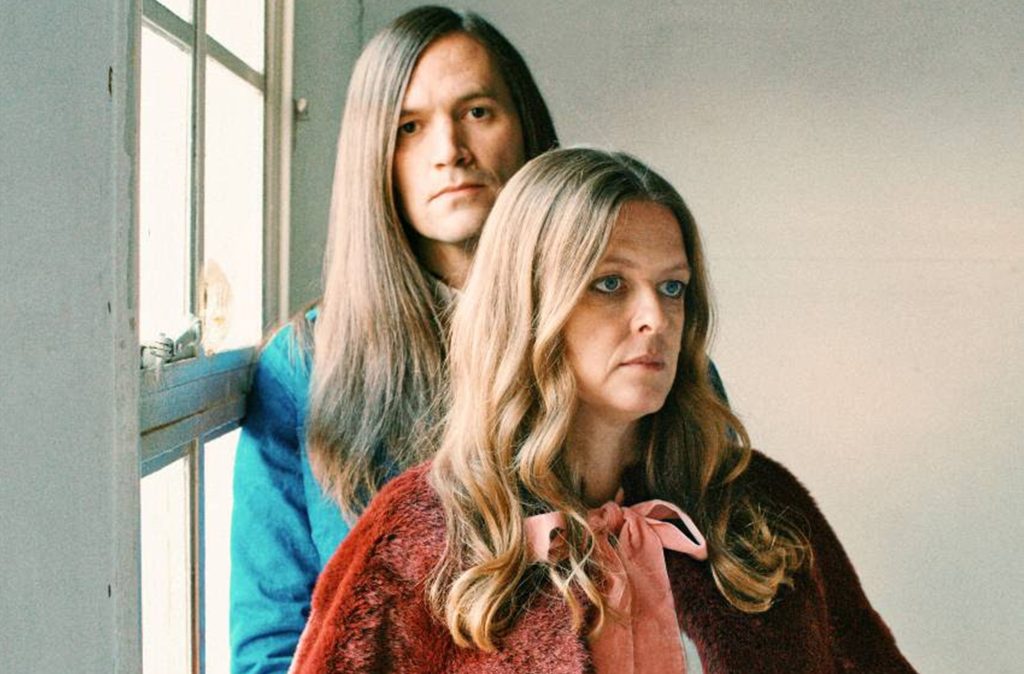
Following the success of Waterslides, MEMORIALS — the project of Matthew and Verity, former members of Electrelane and WIRE — returns with their second album, All Clouds Bring Not Rain, set for release on 27 March 2026 via Fire Records. Promising to take listeners “above the clouds,” the record explores complex textures, unconventional rhythms, and a fusion of influences ranging from folk to dub, from post-punk to spiritual jazz. Recorded in an isolated barn and entirely crafted by the duo, the album reflects creative freedom, meticulous attention to detail, and a pursuit of a singular sound, where simplicity and complexity coexist naturally.
By Sandra Pinto
In this interview, Matthew and Verity discuss the songwriting process, the inspiration drawn from external artistic experiences, the challenges of translating such musical density into live performances, and the poetry that permeates every track of All Clouds Bring Not Rain.
All Clouds Bring Not Rain promises to take listeners “above the clouds.” How would you describe this second album compared to your previous work?
Matthew: I think the suggestion was more that we’ve left the numerous Waterslides of our first album behind at last! I think this record continues to explore what we discovered when we started working together, it’s all just the two of us and ideas are easy to develop, or not! And then we look for a better one. Each record or soundtrack we make throws up new ways of working. We approached this album with a bit more consideration as to how we wanted it to sound when we had finished, and the songs were all written before we started recording, whereas on the first we wrote and recorded them over time.
The album was mostly recorded in a secluded barn studio in the woods. How did this environment influence the sound and atmosphere of the record?
Matthew: I love recording at home but the one huge advantage about paying to go somewhere else that is secluded and quite isolated is the focus it brings, there is freedom to work very long hours which allows you to really immerse yourself in what you are doing.
The lead single, “Cut Glass Hammer,” was inspired by Yoko Ono’s work at the Tate Modern. How important are external artistic experiences in your songwriting process?
Matthew: Good art is endlessly inspiring! For as long as I can remember I’ve been curious of “how did they do that?” It’s satisfying applying some of things you discover to your own work and seeing how it moves things in different directions…
With a poetic title like All Clouds Bring Not Rain, is there a central concept or narrative that connects the songs?
Verity: We named the album at the very end of making it and came across the phrase by chance – it’s from the Elizabethan era – and I think its prod towards optimism is there in the record. But it all depends whether you want rain or not doesn’t it, if you’re waiting for it and it doesn’t come, the phrase takes on a very different meaning, and I think that duality is there in the record. We chose the phrase as the title quite instinctively though, and its only looking at it now from a bit of a distance that I’m making these connections.
Matthew: we had noticed a number of cloud references alongside other repeating themes on the songs that made up the album so when Verity said the phrase to me and I think we both instantly thought there it is! From then on that stuck as the title, we tried to replace it but nothing else seemed to fit quite as well…
Many tracks, including “Cut Glass Hammer,” explore unusual time signatures and interweaving synth lines. What is your approach to creating such intricate and dynamic arrangements?
Matthew: I’ve never sat down to write in any given time signature, I just find things that I like the sound of and run with it, often discovering afterwards when trying to add another element to an initial idea that it’s in a weird time signature or there is a cross rhythm etc… working on some of these new songs presented a challenge in that you can count them in different ways so where one hears the beat can be different to the other… but even that has its advantages… the drum pattern for the song ‘Bell Miner’ Verity played on top of a half beat different to where I intended the 1 to be, but once I’d got my head around it and listened, it sounded magic to me and we arrived at something I wouldn’t have done instinctively!
“Cut Glass Hammer” is described as deceptively simple yet complex. How do you balance simplicity and complexity in your songwriting?
Matthew: It’s best not to think about it and do what comes naturally!
The album draws on folk, dub, post-punk, spiritual jazz, and Canterbury prog. How do you manage to merge these influences without losing the band’s own identity?
Matthew: All these labels are all only tagged on afterwards! There’s no conscious effort to merge or manage anything when we are working together beyond doing what we think sounds good and interests us…
You wrote, performed, recorded, and mixed the album entirely as a duo. What challenges and advantages did this intimate, self-sufficient approach bring?
Matthew: working as a duo brings many advantages – it’s easy to make decisions and move forward with ideas and I’ve definitely enjoyed being able to spend more time with instruments than I would if there were other more proficient musicians around to play them! But we do find we are very much lost in our bubble and receive little feedback from those around us so it can be difficult to remain sure of the path you’re following when doubt creeps in…
Capturing sounds in real spaces rather than relying on digital samples is clearly important to you. Why is this aspect so central to your sound?
Matthew: It’s really important to not sound the same as everyone! Where is the fun in that? It’s noticeable how the same wonky mellotron sound available in the same software that everyone uses isn’t so interesting when it’s the same sound you hear all the time! Homogenisation in music production is boring! Digital samples are great, but I’d prefer to make my own!
You worked in several different studios to record instruments like harpsichord, vibraphone, and a vintage Leslie speaker. How did these choices shape the final texture of the album?
Matthew: These choices were all central to achieving what we heard in our heads! We visited different places to get to use instruments and equipment we didn’t have access to or couldn’t yet afford to own! The Leslie speaker became a bigger part of the record than we might have guessed once we discovered how great it sounded on the vocals…
How do you plan to translate the complexity and density of the album into your live performances?
Verity: That’s our project for the next two months, to work that out! There will be rougher edges, different arrangements, perhaps some new instruments on tour with us if we can fit them into our Tetris van pack. We’ll be guided by what works live, and what is exciting to play together, rather than trying to reproduce exactly what’s on the recording.
After touring with Stereolab across the USA, have you noticed any change in how you interact with audiences or interpret your songs live?
Verity: the audiences at the Stereolab shows were very kind to us, we had some of our favourite ever gigs so far on that tour. I didn’t notice any particular changes in us, but I think because we’ve been enjoying touring it’s left us feeling keen to get back out on the road and play the new songs.
Having recently composed the soundtrack for a documentary about Kate Bush, how did that experience influence your approach to this album?
Matthew: One excellent influence was a technical one rather than creative, as it was through the brilliant director Sonia Gonzales that suggested the studio St Rémy (in Southwest France) to work in for the soundtrack in March 2025… the songs for All Clouds were written from summer 2024, having finished Waterslides in Jan 2024 and having a 6 month break from writing… so there wasn’t a huge creative influence but getting to know her work was definitely inspiring… particularly in her way of realising her vision on her own terms…
If you had to describe All Clouds Bring Not Rain in three words, which would you choose and why?
Matthew: This is a really hard question… it’d change multiple times a day but 3 words for now can be Unique, Ambitious & Heavy and as for why… the music can answer that!
What kind of emotional experience do you hope listeners take away from an album that is both melodic and experimental?
Matthew: I’d dearly like to imagine it is an acceptable experience.
Photo: David Masters