


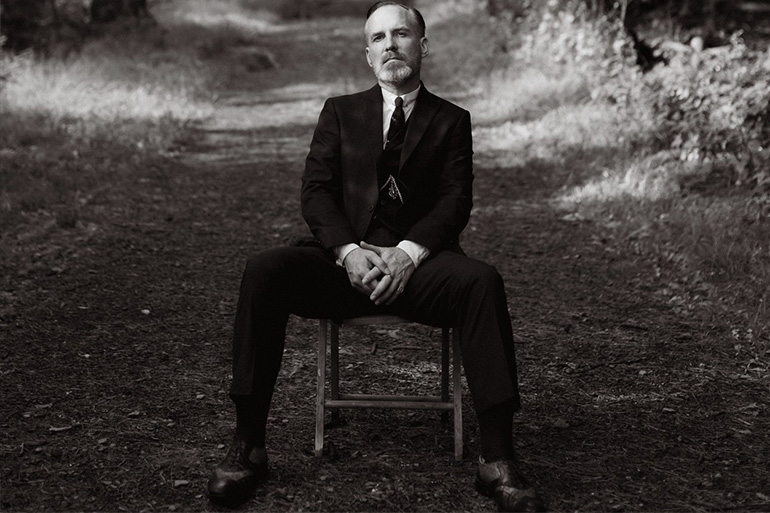
Lost Signal is the electronic music project of Charles Rehill, based in New York State, known for his collection of synthesizers and inspiration from composers such as Vangelis and Ólafur Arnalds. With his new album Light of Other Days, Rehill creates soundscapes that explore memory, mortality, and fragile hope, guided by dense atmospheres that tell stories beyond words. From his early start in electronic music to collaborations with close friends and producers, Lost Signal transforms personal experiences and cosmic reflections into an immersive sonic journey.
By Sandra Pinto
In this interview, he shares his creative process, the concept behind the album, and the next steps in his career.
How has your passion for synthesizers and inspiration from artists like Vangelis and Ólafur Arnalds influenced the sound of Lost Signal?
I think that I tend to write and compose from a place of setting a mood first and rely heavily on the atmosphere to help tell the story. I know it’s not always the case, but I come from a place where I want the lyrics and feeling I’m trying to convey fit perfectly with the emotion that the synthesizers are creating. Getting back into Lost Signal after an extended hiatus, I spent years composing ambient, which helped tremendously.
You started your career by signing a record deal as a teenager. How did that experience shape your path in electronic music?
It was probably a deeply different experience than most, but it did lead to my career. At the time, I had no budget for equipment and I had very little skill. I was extremely fortunate to have a friendship with Tom Shear of Assemblage 23 who helped me by producing my first album. After that, it took me a few years to amass what I needed on my own to match that production value and skill that Tom possessed. By the time the record label folded, I was working in music.
What is the story and concept behind the new album Light Of Other Days?
As a coping mechanism, I tend to find peace in cosmological concepts. As a child, I was obsessed with the program “Carl Sagan’s Cosmos” and will still re-watch it for comfort. I think that the knowledge and ponderance of our own insignificance within the universe helps to keep me calm and grounded in times of stress- and pushing that thought further to the impermanence of everything around us drove the narrative that I was crafting with Light of Other Days. “Entropy” came to life first, which I think outlines the idea behind the album- the paradox of “forever” in our own memory in stark contrast with the fleeting nature of existence.
The album deals with themes like memory, mortality, and fragile hope. How do you approach these themes in the composition and production of the tracks?
In my process, I tend to focus on a mindset and feeling; like an emotional state from which to write. During this process, I think I wrote something like 20 or 30 songs, all of which reached various stages of completion- but at the end I chose the ten that I felt were the most cohesive to the narrative and theme of the album as a single work. It was an extremely difficult and frustrating process, one that I nearly walked away from when it was nearing the finish line just to give myself a break. I’ve been overwhelmed by the response though, which has helped me to trust my instincts.
‘Not The End Of Me’ is a raw portrayal of perseverance in moments of doubt. What was the inspiration for this song, and what does it represent to you?
“Not the End of Me” was one that I struggled with. It’s self-realization that overcoming depression isn’t always a triumph of the will; that it can also be a defiance of will. It’s a grim view, but it’s about perseverance on the brink without fully understanding the “how” or the “why” of continuing. I was quite bashful to let people hear this song at first as it is probably the most personal I’ve ever written. It’s an admission that I have to make to the people around me that don’t know me this intimately.
The album is structured with the instrumental tracks ‘Departure’ and ‘Return’ framing the rest of the work. What is the significance of this narrative choice?
Taking it back to the “Cosmos” reference earlier, I envisioned the album as a disembodied journey through time & space while grappling with human questions. I felt that having a starting point as well as a homecoming grounded the overall work.
How was the collaboration process and selection of remixes for ‘Not The End Of Me’ and ‘Entropy’?
Believe it or not, aside from a single remix that was released prior to “Catharsis” in 2001, I have never released remixes of my songs. Things have changed considerably in recent years, and all of those selected for this round are already close friends and collaborators. I’m close with David Dutton of genCAB so I reached out to him about “Entropy” as I was finishing it up. Magic Wands and I did a remix trade, and I completed one for their single “Armour.” Clint Carney is another dear friend who has helped me tremendously with his animation skills for both “Anatomy of Melancholy” as well as “Light of Other Days.” Lastly, Tom Shear and I have a shared history as I mentioned earlier, and I was delighted and honoured when he agreed to do a remix for me.
What role does the Lost Signal project play in your parallel career working with synthesizer manufacturers?
I’ve been incredibly lucky in my professional career. I’m extremely passionate about synthesizers and music production, and as such the two have always been mutually beneficial. Having practical, real-world experience with instruments has given me some insight to help guide decisions that hopefully adds some value. It’s also given me access to resources and people I won’t normally have had the opportunity to interface with. Recently, a close friend of mine who has a synthesizer company “muSonics” just built for me a custom synthesizer that I’ve already put to good use.
The track ‘Entropy’ expands the theme into a cosmic reflection. Could you tell us more about this idea?
I think the track “Entropy” speaks to the paradox of “forever.” With regard to the themes within “Light of Other Days,” I feel that “Entropy” plays with the discord between knowing in one’s heart that something is permanent- or as permanent as it can be, while knowing that even the sun will eventually burn out, the stars will fade, and the universe will end. I think that this can be both viewed as nihilism as well as optimism, since we hold the capacity for both things to be true simultaneously.
What are your plans for the future after the release of Light Of Other Days? Are there any tours or new musical projects planned?
I’ve just begun performing “Light of Other Days” live, and plan on doing more extensive touring to support this album in 2026. I’m already hard at work on new material that may coalesce into a new album or EP to follow, as well as a few collaborations that I’ll be excited to share as they get a little further along.