


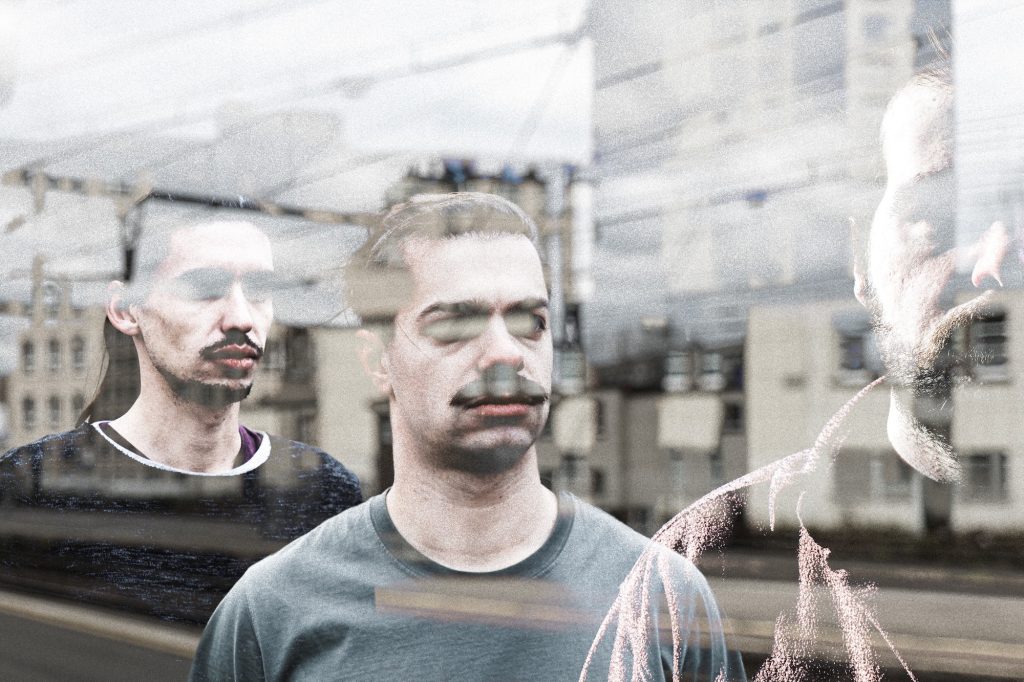
With Anthropolis, KO-MA dive into a haunting vision of the contemporary city, transforming the urban space into a distorted mirror of today’s society. Described as a “dystopian fresco,” the album builds a narrative where tension, collapse, and collective identity intertwine, shaping a dense and immersive sonic universe.
By Sandra Pinto
In this interview, the band reveals how this concept developed from its earliest ideas to the final compositions, exploring the relationship between sound and storytelling. Blending influences from post-hardcore, punk, and noise, and moving between raw aggression and atmospheric moments, Anthropolis emerges as a work defined by emotional intensity and experimentation. Throughout the conversation, they also discuss the role of improvisation, the importance of live performance, and the next steps for a project in constant evolution.
The album is described as “a dystopian fresco of the modern city.” How did the idea to create this urban concept come about?
The idea came very early in the process. The title itself was almost the first thing that emerged. We discussed the themes together and outlined the overall narrative structure before Léo started writing the lyrics once the first instrumental demos were ready. From that point on, we composed the music with the fiction already in mind. The sound and the story naturally influenced each other throughout the writing process.
Anthropolis explores the slow decay of the contemporary city. What messages or feelings did you want to convey to listeners?
The city in Anthropolis represents society as a whole, the collective entity that shapes us while we also shape it in return. We wanted to explore how individuals influence one another, and how, when gathered together, they create something larger that can both reflect and distort their humanity.
The lead single, T-Faked, is already out. Why did you choose this track to introduce the album?
T-Faked captures many of the core elements of the album. It reflects both the narrative tension and the sonic identity of Anthropolis, with dense and fast-paced sections that translate the sense of urgency and instability present throughout the record. It felt like a natural entry point into the album’s world, both musically and conceptually.
How has your sound evolved from the EP TRENCADIS to this first full-length album?
With Anthropolis, we pushed further into atmosphere and narrative cohesion. The album is more structured conceptually, and we explored denser textures and more contrasting dynamics.
You blend post-hardcore, punk, and noise. How do you balance raw aggression with ethereal nuances in your compositions?
It’s something we’ve developed over time, especially through live performance, it’s what feels natural to us. Alternating between intense and quieter passages requires control though. We try to maintain tension even during calmer moments, while allowing the more aggressive parts to fully release energy. This contrast helps reflect the emotional and psychological themes of the album.
Your work deals with anxiety, resilience, and freedom in a self-destructive system. Do the lyrics come first, or does the music guide the words?
It’s a mutual process. For Anthropolis, the narrative concept existed early on, but each instrumental composition inspired specific themes and emotions. Writing lyrics then became a way to structure those ideas and explore them more deeply. For us, writing is also a form of release, almost like meditation, allowing us to process complex emotions and reflect on them.
Did any tracks on the album emerge completely through improvisation, as happens in your live shows?
Some elements definitely came from improvisation. Our noise sessions, like Blurry and Blurry II, originated from live improvisations and influenced the more experimental and chaotic aspects of the album. Even within more structured tracks, improvisation helped shape textures and transitions.
Bands like Birds in Row, La Dispute, Fugazi, and Sonic Youth are cited as influences. How did these bands shape Anthropolis?
These bands influenced both our sound and our approach to composition. We’re inspired by their ability to combine intensity with atmosphere, and to create emotional depth through raw and sometimes unconventional structures. Their influence encouraged us to embrace contrast, experimentation, and narrative-driven songwriting.
Are there experimental elements on this album that you’ve never explored before in your sound?
Yes, particularly in terms of noise textures and structural experimentation. We explored more layered and chaotic soundscapes, as well as more fragmented arrangements. The conceptual nature of the album also pushed us to experiment with transitions and sonic continuity across tracks.
With over 70 performances across Europe, your shows are known for intense “noise sessions.” How do you translate the energy of Anthropolis to the stage?
Live performance has become an essential part of our identity. Playing these songs on stage allows us to push their intensity further and adapt them in real time. The energy of the audience and the physicality of live performance naturally amplify the tension and atmosphere present in the album for us.
What is your approach to improvisation during live performances?
Our noise sessions are moments where we let go of structure and explore textures and dynamics freely. These moments keep the performance alive and unpredictable, while still remaining connected to the emotional core of our music.
After releasing Anthropolis, what are the band’s next steps in terms of touring or new projects?
Our main focus is to bring Anthropolis to the stage as much as possible. Touring is essential for us, both to share the album and to continue evolving musically. At the same time, we’re currently experimenting and gathering new ideas in order to shape future material.
Do you plan to expand the dystopian concept of this album in future releases, or keep each work with its own identity?
Each release has its own identity, but we’re naturally drawn to similar themes: societal tension, human behavior, and collective dynamics. We’re also exploring new ideas at the moment though, still connected to the universe of Anthropolis.