


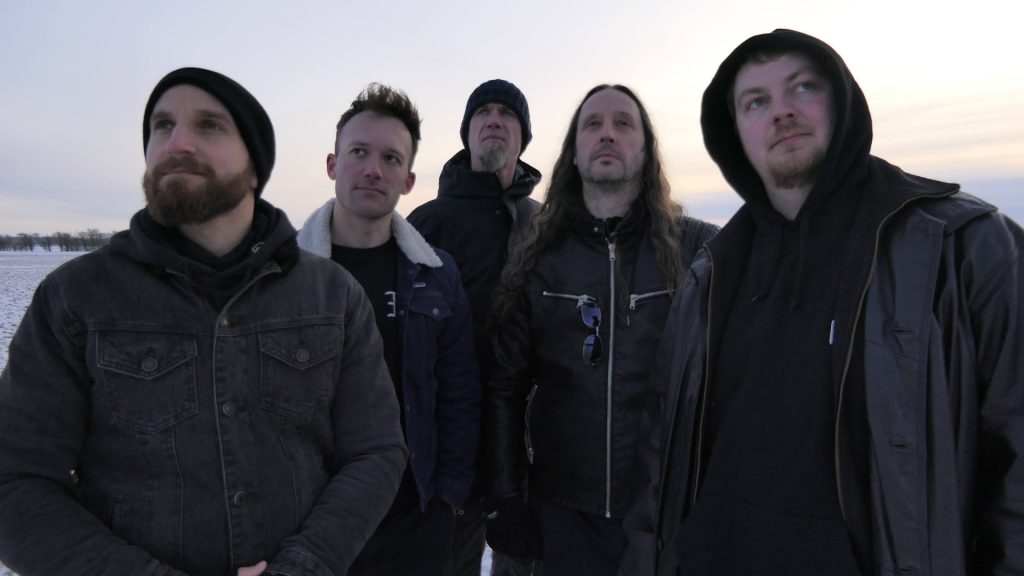
There is something deeply human about looking towards the stars while still struggling to understand what is happening inside ourselves. That contradiction lies at the heart of Liminal, KINETIC’s ambitious 106-minute conceptual album, which follows humanity’s evolution through the Kardashev Scale while exploring the fear, isolation, identity and search for meaning that remain with us no matter how far technology takes us. Following their 2025 debut EP Sentience, KINETIC take their progressive metal into a much broader territory, bringing together cinematic atmospheres, science fiction, philosophy and increasingly complex musical structures. “Dyson”, the second chapter in the album’s three-part visual narrative, turns the idea of a Dyson Sphere into something far more personal, exploring paranoia, isolation and the fragile line between reality and perception.
By Sandra Pinto
We spoke with Marcus, who handles synthesizers, and with David, who plays the guitar in KINETIC, about the making of “Dyson” and Liminal, the ideas behind the band’s vast conceptual universe, the relationship between technological progress and the human condition, and how KINETIC turn concepts that span galaxies and civilisations into something deeply personal.
“Dyson” explores paranoia, isolation, and inner conflict. What led you to place these ideas at the centre of both the song and the music video?
Marcus -Before “Dyson” became “Dyson”, it was simply a song written from a place of isolation and inner conflict. I was sitting alone in another country for an extended period, missing my family and reflecting on the past – old memories, familiar places, and the things that suddenly feel much more significan when you’re far away from home. That state of mind immediately translated into music, and the song came together almost instantly.
After sharing it with the rest of the band, we all agreed that it belonged within the Liminal universe. At the same time, it offered a welcome change of pace from some of the more progressive and complex songs on the album – a kind of musical getaway without feeling disconnected from the overall narrative.
The main theme and title “Dyson” naturally place the song within the timeline of the Kardashev scale. However, because the song differs somewhat from the rest of the album, we felt that its lyrical narrative could also deviate from the strict progression of that timeline. Instead of focusing solely on humanity’s technological advancement, the song explores what happens when we have evolved to such an extent that entirely different problems begin to emerge.
Perhaps the most interesting part is that these problems may not be new at all. Despite our technological and evolutionary progress, some of the conflicts we face could simply be fundamental parts of being human – loneliness, longing, isolation, self-doubt, and the struggle to understand our place in an ever-changing world.
The title “Dyson” immediately evokes the concept of a Dyson Sphere and the harvesting of energy on a cosmic scale. How does this idea connect with the wider story you tell throughout Liminal?
Marcus – The idea fits the narrative because humanity has now reached a point where it is capable of harvesting energy on a cosmic scale. The story follows humanity’s expansion chronologically mirroring the progression of the Kardashev Scale. At first, humans reaches the point where it can fully harness the energy available on its own planet. However, this does not necessarily give us an “excess” of energy – we are still fundamentally limited by the resources of our home world. Once we advance to the point of harvesting the energy of stars, now we suddenly have access to an enormous surplus of energy, allowing us to push technological development further and expand our ability to explore beyond our own solar system, and eventually, into the wider universe.
In that sense “Dyson” represents a turning point in the story: humanity is no longer simply trying to survive or master its own planet, but has acquired the energy and technological potential to begin reaching far beyond it.
The music video places its protagonist somewhere between objective reality and a reality distorted by his own mind. To what extent can our personal perception become more powerful than reality itself?
Marcus – That’s a very good question because what is reality really? Is there such a thing as a completely objective reality, or are we all simply striving toward a shared version of “objective” reality – one constructed from the subjective interpretations of individuals, or perhaps from the collective interpretation of many people?
On an individual level, I think our perception can become more powerful than reality itself because it determines how we experience the world and how we choose to live, behave and act within it. The same thing can mean everything to one person and almost nothing to another.
An idea or belief can become so powerful within someone’s understanding of reality that it begins to define what they believe reality should be. And when that belief influences other people – their actions, values, or even the way they understand the world. It begins to exist beyond the individual who created or adopted it.
In that sense, a personal perception can become more powerful than reality itself. What begins as one person’s subjective interpretation can eventually shape the “objective” reality experienced by many others. At that point, the distinction between perception and reality becomes increasingly difficult to define, because the perception itself has started to influence the world (or reality) around it.
The band describes the video as a reflection on whether many of humanity’s greatest conflicts originate within ourselves. Do you believe that some of our biggest struggles are ultimately internal rather than external?
Marcus – Definitely. There is a study saying that 70-80% of our worries never happen. When I was younger, I tended to overthink things a lot, but with time and experience, I’ve come to realize that worrying rarely gets you anywhere. It doesn’t change the outcome – it just makes you experience the problem before it even exists.
One technique I’ve started using is to give myself a “worry window” in the evening – a specific period where I’m actually allowed to sit down and worry about whatever is on my mind. Whenever a negative thought or a moment of overthinking pops up during the day, I try to tell myself “we’ll deal with that later, when the worrying window opens”. By the time the “worrying window” actually arrives, I’ve often forgotten what it was I thought I needed to worry about in the first place.
How did working with Marcus H. Levin help you translate such psychological and abstract themes into a visual narrative?
Marcus – Luckily, since I also made and edited the video myself, I had a pretty clear idea of how I wanted everything to come together in the final cut. That made it very easy for me to visualize what we needed while filming, so sometimes, I had to just tell the guys “do this – you’ll understand when you see the final video”or “you’ll get it later” if they were confused, haha.
The video constantly shifts between the protagonist’s perspective and an external viewpoint. Was this change in perspective also intended to challenge the way the audience interprets what is actually happening?
Marcus – Definitely. At one point, you are the protagonist: then suddenly, you’re not. You become an observer, watching yourself from the outside, before shifting back again. This was intentionally designed to challenge the viewer’s interpretation and perspective – and, ultimately their understanding of the “reality” we’re showing them.
That same uncertainty is what the protagonist experiences throughout the video. The viewer is placed inside his perspective, only to have that perspective questioned moments later. In that sense, the way the audience experiences the video mirrors what is happening to the protagonist himself; the line between what is real, what is perceived, and what is imagined gradually becomes blurred.
You have described “Dyson” as one of the album’s most immediately accessible songs. What makes this particular track the right introduction to KINETIC for people who are discovering the band for the first time?
Marcus – Generally, our music doesn’t start by immediately hitting you in the face. We like to build things gradually, letting the music develop toward its climax and taking the listener by the hand as we guide them through the journey.
Progressive metal obviously isn’t everyone’s taste, but we want to introduce our sound to a broader audience – hoping that “non-progger’s” might be curious about the rest of the album. “Dyson” is more straightforward and accessible in terms of its listening experience compared to some of the more progressive sections on the album. In that sense, it can serve as a more approachable introduction for listeners who might normally be scared away by something being described as “prog”. Hopefully, once they’re through the door, they might discover something that gives them an extra ear for the rest of the album.
Whereas some of the other songs focus heavily on taking the listener through a specific part of the overarching storyline and that associated emotion, “Dyson” might be more relatable on a personal level. It deals with themes like inner conflict, isolation, overthinking, and the struggle with your own perception – things that, in one way or another, most of us have experienced at some point in our lives.
Liminal follows your 2025 debut EP, Sentience. What has changed most significantly in KINETIC’s identity between the EP and this debut full-length?
David – The band’s identity remained mostly the same – however the confidence in the music grew significantly after receiving so many positive reactions. With the Sentience EP we definitely solidified our production sound – that whole EP shaped the soundscape for the full length album. The album has so many more vignettes and moods than the EP, so the listeners get to see many other sides of KINETICs identity and sound.
Liminal runs for 106 minutes and is structured as one continuous conceptual narrative. When did you realise that the story needed to be on such an ambitious scale?
David – As we developed the ideas, we realised that we didn’t want to compress everything into three or four conventional songs. The different stages of the story needed room to breathe, and some ideas needed to develop slowly. Actually we had a few more songs planned for the album storyline, but in the end this is what we ended up with.
The Kardashev Scale is one of the key inspirations behind Liminal. What fascinates you most about this concept, both as musicians and as human beings?
David – What fascinates us is that such a simple scientific idea opens up an enormous philosophical question: what would humanity actually become if we had access to that kind of power? The Kardashev Scale measures technological progress through energy consumption, but it doesn’t measure wisdom, empathy, happiness or psychological development. You could theoretically become a Type II or Type III civilisation while still carrying all the same internal conflicts we have today. That contrast became very important to Liminal.
The idea of measuring the advancement of a civilisation by the amount of energy it can harness is scientific, but also deeply philosophical. What questions about humanity did you want to explore through the album?
David – We were interested in the gap between what humanity is capable of achieving and what we are actually capable of understanding. We can build machines that can see billions of light-years into space, manipulate enormous amounts of energy and potentially change the planet itself. But we still struggle with fear, identity, loneliness, conflict and our own sense of purpose. So underneath all the science and cosmology, Liminal is really asking what happens to the human being as the civilisation around them evolves.
Liminal appears to explore both humanity’s technological development and its internal conflicts. Is there a contradiction in being capable of reaching for the stars while still struggling to understand ourselves?
David – Absolutely. And I think that contradiction is one of the central ideas of Liminal. Humanity has always looked outward for answers. We explore space, develop technology and try to understand the universe. But at the same time, we still have enormous difficulty understanding ourselves. In a way, the further outward we go, the more we are forced to confront the question of what we are carrying with us. Technology can change our environment, but it doesn’t automatically resolve the human condition.
Musically, you favour long-form compositions and structures that move away from conventional verse-chorus songwriting. Did the narrative determine the musical structures, or did the music itself eventually shape the story?
David – It was both. The narrative gave us a framework, but the music constantly changed our understanding of the story. Also we are always jamming and improvising a lot when we practice. This constantly led to the songs changing and becoming more and more evolved and thus longer usually. Sometimes we would have an idea for a particular scene or concept and write music around
it. Other times, we would create something musically and realise that it represented a completely different emotional state than we had originally imagined. That interaction between the conceptual and the emotional was very important. We didn’t want the music to simply illustrate a story. We wanted the music itself to tell part of it.
You have cited bands such as Tool, Deftones, and Pink Floyd as references for the atmospheric and cinematic side of KINETIC. What other artists, albums, films, books, or works of art influenced the creation of Liminal?
David – Science fiction Novels of dystopian futures like 1984 played a role. In general. We were particularly inspired by the idea of using something enormous and almost incomprehensible — galaxies, evolution, civilisation, cosmic time — as a way of talking about something extremely personal. We have the sounds of black holes in the mix, recorded space sounds of possible extraterrestrial life etc.
How do you balance the technical precision of progressive metal with the emotional and atmospheric elements needed to serve such a complex narrative?
David – For us, technical complexity only has value if it serves the emotional experience. Progressive metal can sometimes become very focused on complexity for its own sake — odd time signatures, difficult riffs and technical performances. We love that side of the genre, but we don’t want the listener to hear the mathematics before they hear the emotion. The challenge is to make something technically demanding still feel natural, memorable and emotionally meaningful. The complexity should disappear into the music rather than become the point of the music.
Liminal was produced, engineered, mixed, and mastered by Frederik Uglebjerg. What were you looking for in the production, and what did he bring to the album that helped define its final sound?
David – Frederik Uglebjerg is also a big time prog guy. He comes from many of the same influences as some of KINETICs band members. We just knew he would understand our message and the importance of letting the music breathe and evolved. We could not have had a better sound technician on the album.
The album brings together science, philosophy, psychology, and cosmic concepts. How does KINETIC approach the challenge of turning such complex ideas into music that can still connect emotionally with the listener?
David – We don’t expect the listener to understand every scientific or philosophical concept behind the album. The concepts are more like a framework for the emotions underneath them. You don’t need to know the details of the Kardashev Scale to understand ambition, fear, isolation, hope or the feeling of being overwhelmed by something much larger than yourself. For us, the best outcome is when someone can experience the album emotionally first and then discover the deeper layers afterwards.
Liminal will be represented through three music videos, with “Dyson” being the second. Do the three videos form a connected visual narrative, and should listeners experience them as different chapters of the same story?
David – Yes. The three videos are connected and are intended to function as different chapters within the same larger narrative. Many of the colour schemes are similar. They don’t simply visualise the songs literally. They explore different aspects of the same journey — particularly the relationship between humanity’s technological evolution and the psychological consequences of that evolution.
With “Dyson”, for example, the cosmic idea of a Dyson Sphere becomes a metaphor for something much more internal. The more humanity tries to control and harness the universe around it, the more we are forced to confront what is happening inside ourselves.
Your debut EP, Sentience, established KINETIC within the progressive metal scene. Do you see Liminal as a major artistic leap, or simply as the natural evolution of what you started with the EP?
David – I think it is both. It is a natural evolution of what we started with on Sentience, but it is also a pretty significant leap in ambition.
Sentience was us discovering what KINETIC could sound like. Liminal is us discovering how far we can take that idea.
The EP was more focused on establishing our identity sonically, whereas Liminal allowed us to combine everything we are interested in — progressive metal, atmosphere, cinematic storytelling, science, philosophy and psychology — into one continuous piece. So I wouldn’t say we’ve abandoned what we started with. We’ve taken it much further.
If you could leave listeners with one central question after they experience Liminal from beginning to end, what would you want that question to be?
David – The goal is to leave the listener with an emotional and musical experience of both fear and hope, questioning the purpose of our life on planet earth. Where are we heading? What does all this progress mean if we don’t answer the simplest questions within ourselves to find actual meaning with life?
