


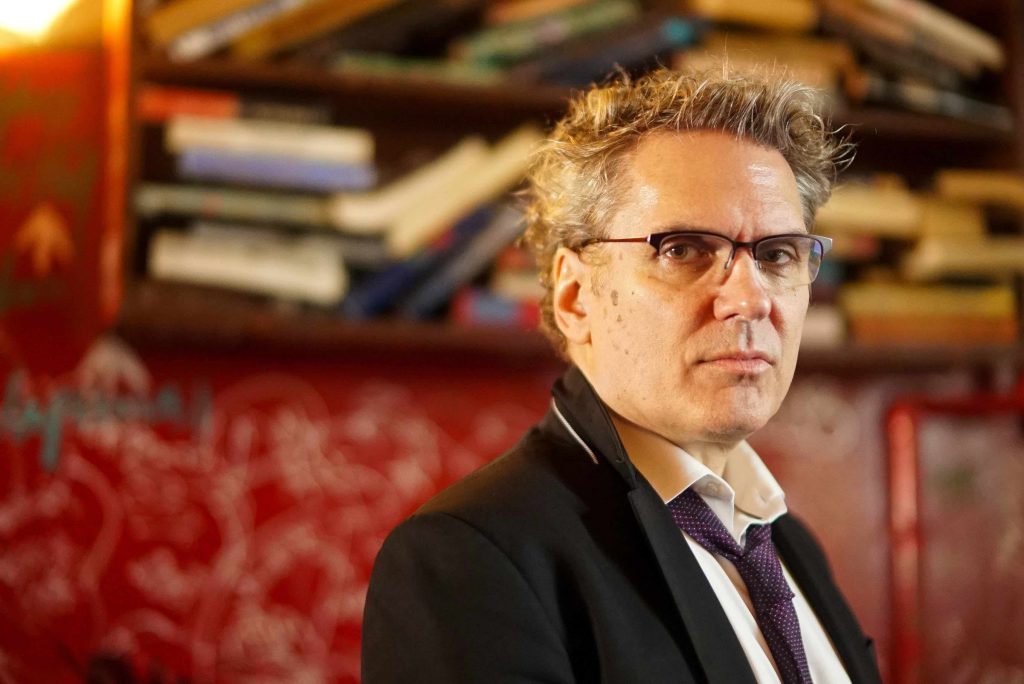
Charlie Nieland returns with Stories From The Borderlines, an album described as a “geography of intention,” where each track becomes its own territory of emotional and sonic exploration. Blending post-punk, glam, dream pop, and progressive rock, Nieland creates musical spaces that are simultaneously intimate and cinematic, delving into themes of connection, separation, vulnerability, and self-illusion.
By Sandra Pinto
In this interview, he discusses the multi-year creative process, pivotal collaborations with artists like spiritchild and Joe McGinty, and how personal experiences and his New Jersey environment shaped the album’s sound and narrative. With a keen awareness of the light and darkness in the contemporary world, Stories From The Borderlines invites listeners to immerse themselves in a rich, detailed, and deeply human musical journey.
Stories From The Borderlines is described as a “geography of intention.” How do you define that phrase in the context of this album?
I like geography as a descriptor for music. I can actually live in the spaces that music creates. Like little vacation homes. The songs on Stories From the Borderlines started as tectonic plates that shifted into their own continents. And I use the term “intention” loosely, to include things that unconsciously bubble up. Once they are in play, I can combine them with ideas that I’m consciously thinking about. It all forms a shape, kind of the way I have as a human being.
The album explores connection and severance. Were these themes present from the beginning, or did they emerge organically as you wrote and produced?
What connects and divides us has been a concern in my songs for a while. But the idea that we create illusory selves in opposition to each other came into sharper focus for me in the years since 2021. From my experience with our siloed social media but also from the idea of self-illusion. A podcast episode of Sam Harris’s podcast Making Sense called Do We Really Have A Self? really resonated with me. This imaginary inner space that we’ve constructed in opposition to the rest of the world leads to the corrosive blaming of the other selves who seem to act freely. Letting go of this special self we think we are is the solvent; the path to connect to the flow state that we actually exist in.
You mention mining for light and truth in a darkening world. How does that philosophy guide your creative process?
I can’t help but see that the flattening darkness calls forth light. I’m not just playing games with words – well, yes I am – but also recognizing that every dark turn we take brings us into a discovery. Failure brings us into contact with the good ideas. It’s the only way there.
The album blends post-punk, glam, dream pop, and progressive rock. How do you balance such diverse influences while keeping a cohesive sound?
I didn’t force an overall sound on the songs. Those are styles that have become a big part of my vocabulary since I was a kid and I allowed them to germinate here and form contrasting spaces. But within each song, I embraced a process of creating a conversation of musical ideas; call and response between melodic, rhythmic and textural forms so that you hear new things with multiple listens. I think that gives those different styles cohesion.
Working with guests like spiritchild and Joe McGinty, how do you decide when to collaborate and when to maintain a singular vision?
I let the songs tell me when they need something. Those collaborations came about at different points in the process. I wrote Win as part Bushwick Book Club’s residency at Banned Book Week at the Kurt Vonnegut Museum and Library in 2022, and spiritchild was also a participant. We all musically backed each other in the performance of our songs at the end of the week and when I presented Win to the group, I knew that spirit was going to bring something electrifying to the song if he rapped on it. The decision came in a flash. He went on to recreate that performance on the studio recording and at other performances of Win just in the past few months. It’s so great.
Today began as something that I played a simple mellotron strings and flute accompaniment on. As the album developed, I felt that it needed more and I knew Joe McGinty would bring something magical to the song. I was so fortunate he said yes. He understood exactly what I was going for and gave me lots of layers and transitionary options. It was wonderful to be able to have such great rapport with both of spirit and Joe.
Your production often contrasts cinematic textures with intimate storytelling. How do you approach this duality in the studio?
The trick for me is to listen to a little radio in my head when the song is emerging and to try and hold on to that sound picture as I let my fingers play ideas. If it goes well, the first things that emerge are just what the song is asking for and those cinematic elements heighten the intimacy in the song stories. Sometimes it goes off track and it turns into something that’s the wrong setting and I have to toss it. Or save it for another song. That’s ok; it eventually leads to the right thing. Sometimes it happens fast; sometimes patience is required.
Many songs feel deeply personal, reflecting family, love, and uncertainty. How do you navigate vulnerability while maintaining artistic distance?
I do have an “art eye” (or ear), that’s busy churning out stuff that feels good to make; sounds that form my musical personality. I guess that could be considered artistic distance. I’ve discovered that bringing the mind of a reporter to the music – bringing a lens to what is happening in my life at the moment and choosing the musical ideas that match that “right now” feeling – that brings the vulnerability and detail that makes the songs real and sustain multiple listens.
The video for “Shame” addresses obsession, lust, and queer identity. How important is visual storytelling in complementing your music?
It’s tricky but really important to show what you’re thinking and feeling rather than just telling. To use imagery, even if it has some non-sequiturs. In Shame, I tried to sing from the point of view of a different character in each verse: first the observer, the waterfront cabaret voyeur and then the observed, the hustler, the queer performance artist. It might take a few listens to get it – or you may never get it, literally – but the gravity of attraction and repulsion that drives the song is visceral and tells the story in images. “You’re looking like a man but you sound just like a girl” “You Black pill incel work of art”. You know who they are.
Your lyrics often explore societal pressures and inner conflict. Do you see your songwriting as political, therapeutic, or something in between?
Hopefully, I leave space that allows the listener to engage in their own way. If it goes somewhere political for them, that’s great. If it brings them introspection and healing, even better. The artists I love like Bowie or PJ Harvey have that ability to leave room for us to have our own experience, even as they cultivate very specific settings.
Having worked with Debbie Harry, Rufus Wainwright, Blondie, and Scissor Sisters, how do those experiences influence your approach to your solo work today?
Originally, for like a decade, I only produced my own music. I thought that maybe I only had the brain-space for that. When I started producing other artists, I learned very quickly that it only added to my appetite to create, plus it exponentially added to my musical toolbox. Working with Debbie was particularly inspiring. I not only produced but co-wrote lots of songs with her for several years. She’s incredibly quick and will come up with a great melody and lyric about something you were just talking about as you’re creating the track. It always inspired me to dive in headfirst, even if the idea isn’t fully baked. You figure it out along the way and that’s the fun part.
You describe the album as a multi-year exploration. Did time allow you to discover new sonic landscapes you might have missed otherwise?
It totally did. For many of the songs, I was unsure about the arrangements beyond a single instrument, the drums and first vocal idea. I tracked that much with Billy Loose – my friend and drummer of 20 years in Her Vanished Grace. Then the songs sat there for a year or so as my partner went through her father passing away, us moving in together and my own mother becoming very ill. I went through a period of caring for her for several weeks at a time, trading off with my brother. After she turned the corner and we got her set up in a new and better situation, I returned to work on the album. Many of the arrangements went jumping forward then. At a certain point each song became populated with enough musical characters that I could step back and experience the whole thing. Then I’d come up with lists of things to try in each song on various instruments and vocals. About half the time, it was like “Nope, the song doesn’t need any more” and the other half, it was “Oh My God, this totally makes the track!” Like the big three part doubled harmonies at the end of Shame. For a while in the back of my head, I’d had an idea to try something like Bowie’s call and response harmonies in “Boys Keep Swinging”. The ending was already full of guitars doing different things but BAM!, when I finally tried the vocal idea, it was the perfect home-stretch thing to bring the song over the finish line. So fun!
How does working in your New Jersey environment, after decades in NYC, shape the music and mood of this album?
Where I live now is full of light and a beautiful breeze blowing off of the Hudson River, right across from NYC. The Brooklyn world that gave birth to the songs was tense and wonderfully grimy, but the final stage of work took shape in Weehawken, and it was the perfect thing to help me bring the final mixes to life.
Stories From The Borderlines feels like a continuation of your previous albums, yet it also marks evolution. How do you see your artistic trajectory at this moment?
It’s a good question. I know I’m on a path. I’m singing and playing out a lot more, with my band, with NJ artist Karyn Kuhl, with The Loser’s Lounge performance series in Manhattan and with the Bushwick Book Club. This has brought me a greater joy in my own voice, literally my singing, but also in a wider sense of the experience of making music in all these situations. This momentum will bring me to the next set of songs, whatever they are. I already wrote one that I really like about the winter solstice for the Bushwick Book Club in December. I’ve been listening to a lot of Stevie Wonder and the Eurythmics and there’s something about grooves that serve amazing songwriting that is calling to me. We’ll see.
With your upcoming audio-visual release in January, are you continuing the same themes, or exploring entirely new territory?
January’s new video single for the song Today is actually from the album Stories From The Borderlines, but it is a twist away from the rhythmic drive of the rest of the record. It’s based on a theme I wrote on keyboards and has a water-like tempo flow with no drums. The amazing Joe McGinty – musical director of The Loser’s Lounge and former Psychedelic Furs member – added his own multi-textured keyboards and really brings the arrangement to life. Video director Alex Dar made a beautiful stop-motion animated music clip that I’m utterly in love with and I can’t wait to share it all. This song deals with loss and acceptance, and it means a lot to me. I made a little making-of video as well, so watch out for that and the music video on my YouTube channel and the socials.
What do you hope listeners take away from this album, in terms of emotion, reflection, or understanding of the world?
I hoped that people would get drawn in enough to listen to a song or two. If they connect with the music, maybe they will listen to the whole album. If they listen to the whole album, maybe they will listen again and start to hear new things and their own changing moods will reveal new ways of seeing the word pictures. I’m feeling like there’s an urgency to recognize the humanity in the people I violently disagree with and to proceed into this chaotic time affording everyone some grace. I hope that someone hearing this music might feel a little of that too.
Foto: Alice Teeple


